Introducing Diagrid + Microsoft Foundry: Durable Agents with Tamper-Proof Executions.
Build AI agents in Microsoft Foundry. Keep them running and prove what they did with Diagrid.

Yaron Schneider
CTO & Co-Founder
AI agents are moving beyond chat. They're calling APIs, updating databases, executing transactions, and coordinating complex business processes.
But building an agent that works in a demo is very different from operating one in production.
What happens when an agent crashes halfway through a transaction? When an infrastructure failure interrupts a multi-step workflow? When an agent executes an action but loses its state before recording the result?
And when an agent says it completed a task, how can you prove what actually happened?
Announcing Diagrid + Microsoft Foundry
Today, Diagrid is available for agents hosted in Microsoft Foundry Agent Service. You can add durable execution and cryptographic execution attestation to the agents you run in Foundry, keep the agent framework you already use, and buy Diagrid through Azure Marketplace.
Together, Microsoft Foundry and Diagrid help enterprises build agents that recover from failures, preserve completed work, and produce independently verifiable evidence of their execution.
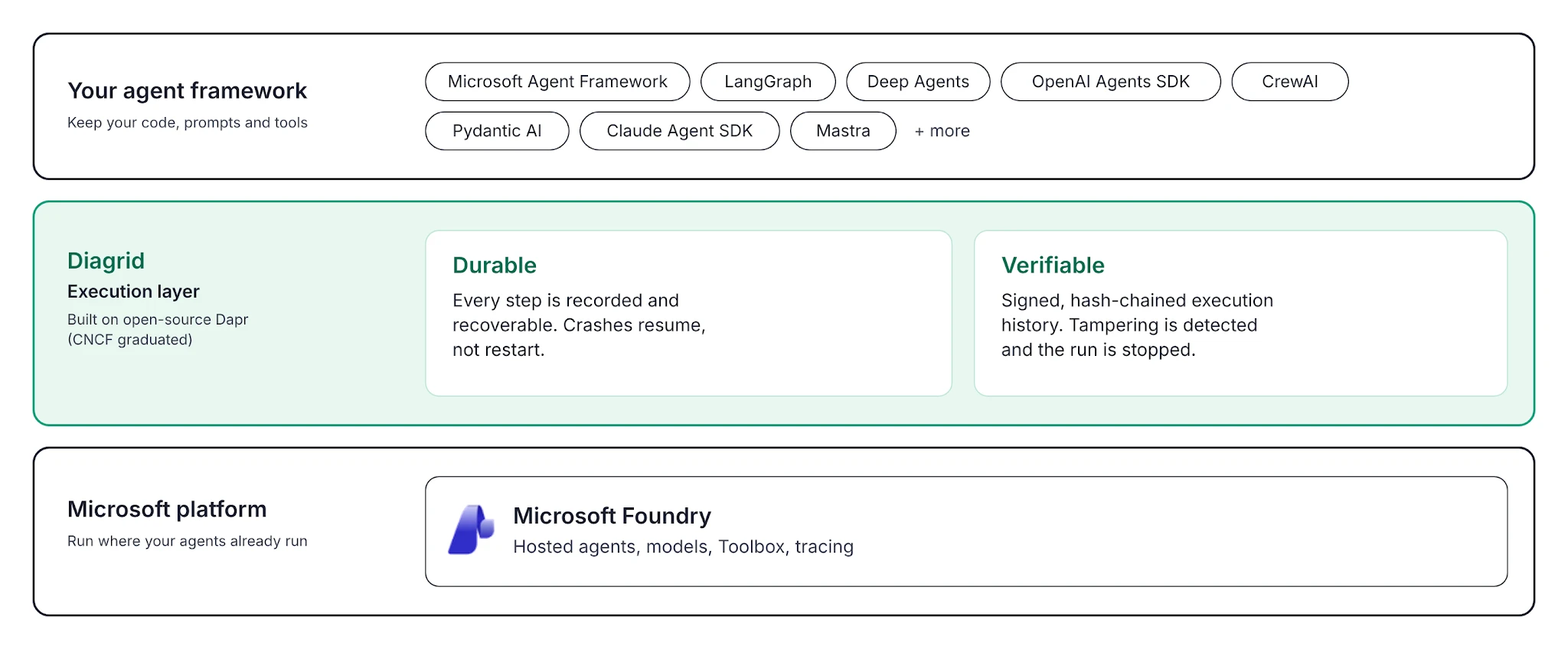
Figure 1. Diagrid adds a durable, verifiable execution layer between your agent framework and Microsoft Foundry.
Agents shouldn't start over when things fail
Microsoft Foundry provides a powerful foundation for developing and operating AI agents, including models, managed hosting, tools, identity, and observability.
Microsoft also offers resilience capabilities through background execution, state persistence, and checkpoint-based recovery that can resume an agent after a process stops. Microsoft's own guidance notes, though, that an interrupted step may run again and that external side effects aren't guaranteed to happen exactly once.
But there's an important distinction between resuming an agent from a checkpoint and recovering its execution step by step, without repeating completed work.
Consider an agent that retrieves customer information, analyzes a request using a model, updates a database, and waits for human approval.
If the agent crashes while waiting for approval, restarting the process isn't enough. The system must know which operations completed, preserve their results, and safely continue from the correct point.
Diagrid addresses this with durable execution built on Dapr's workflow runtime.
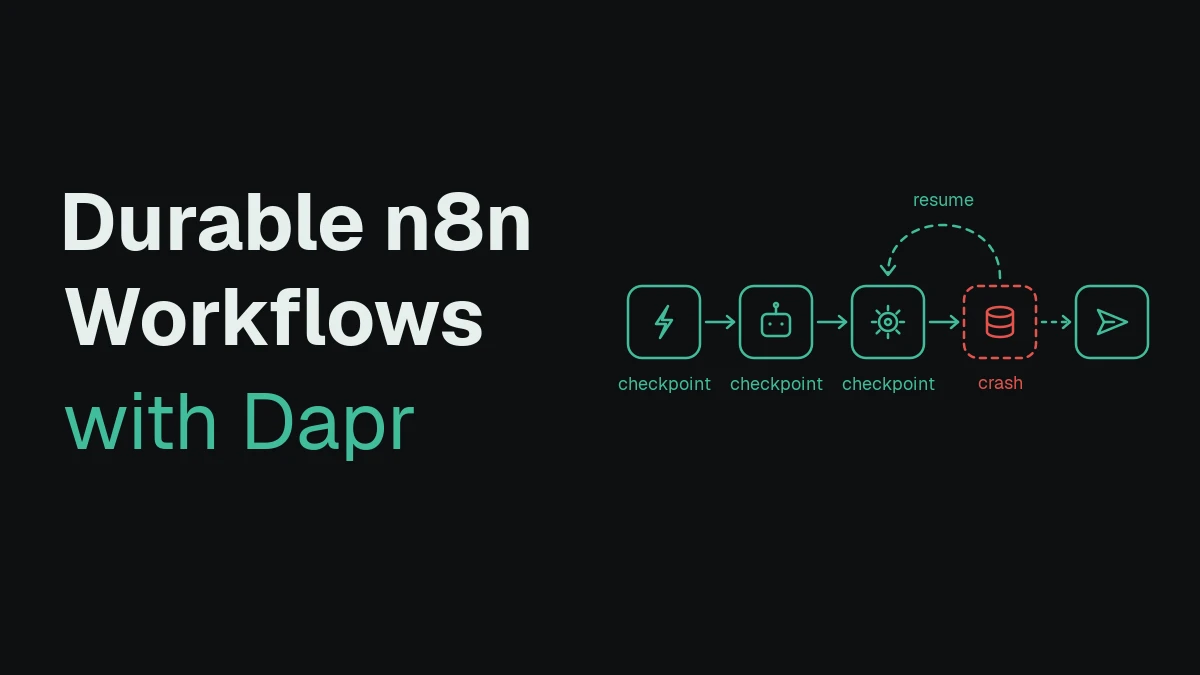
Instead of relying solely on agent memory or periodic checkpoints, Diagrid records the execution history of workflow activities. When a failure occurs, the runtime replays that history to reconstruct the workflow's state.
Previously completed activities return their recorded results rather than executing again.
For AI agents, that means:
- Automatic recovery: Resume interrupted executions after crashes, restarts, and deployments.
- No unnecessary repeated work: Reuse completed LLM and tool results instead of rerunning them during recovery.
- Long-running orchestration: Coordinate workflows lasting minutes, days, or longer, including durable human approval steps.
- Framework flexibility: Bring durable execution to existing agents without rebuilding their core logic or adopting a new agent framework.
Bring your own agent framework
Diagrid isn't another agent framework you need to adopt. It's a durable execution foundation that works with the frameworks developers already use.
Diagrid supports integrations across Python, .NET, Java, TypeScript, and Go, including:
- Microsoft: Microsoft Agent Framework
- OpenAI: OpenAI Agents SDK
- Anthropic: Claude Agent SDK
- LangChain ecosystem: LangGraph and Deep Agents
- Other Python frameworks: CrewAI and Pydantic AI
- TypeScript: Mastra
- Java: Spring AI (early development)
- Go: LangChainGo and Eino (early development)
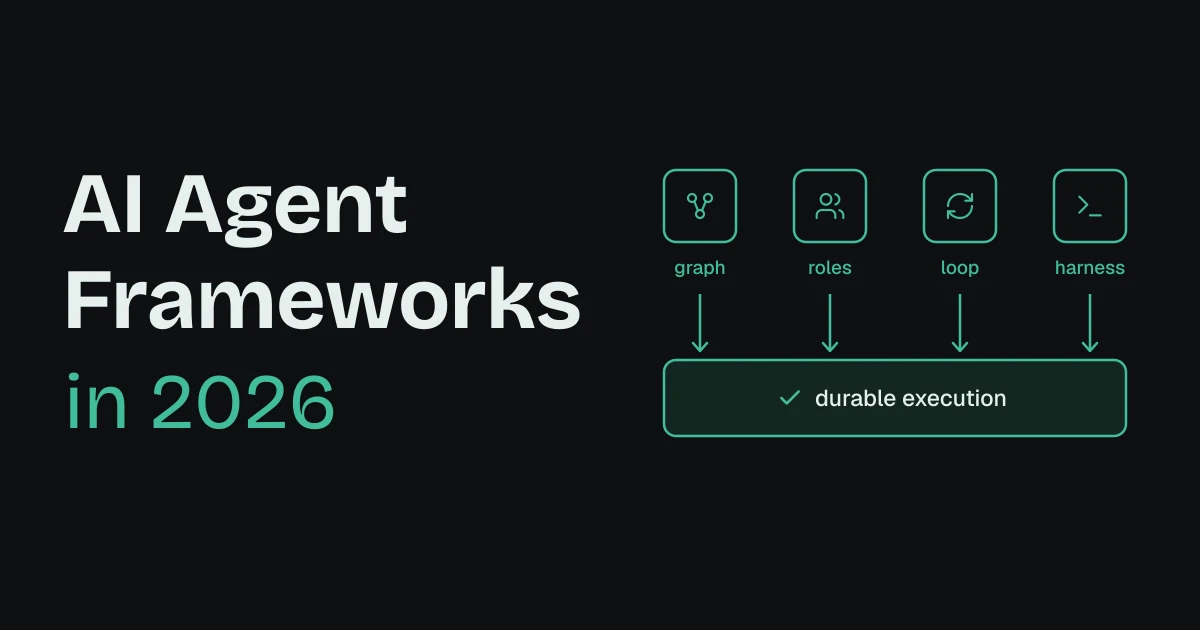
Whether your agents use a graph-based workflow, a multi-agent framework, or a model-driven execution loop, Diagrid provides consistent durability, recovery, and orchestration capabilities across supported integrations.
Developers keep their existing agent logic, prompts, tools, and models. Diagrid handles execution reliability underneath. See the full list of supported frameworks.
The result: agents that continue their work instead of starting from scratch.
Durable execution finishes the work. Verifiable execution proves what happened.
Reliability is essential, but for enterprise agents, completing the work is only part of the challenge.
As agents gain permission to move money, modify business records, and execute sensitive operations, organizations need more than logs and traces.
They need trustworthy evidence.
Imagine an AI agent approves a financial transaction. An auditor needs to establish which operations executed, which systems performed them, what inputs and outputs were recorded, and whether the execution history has been modified.
Traditional observability helps reconstruct what happened. But logs alone don't provide cryptographic proof that the recorded history is authentic and untampered.
This is where Diagrid's Verifiable Execution takes durability a step further.
Cryptographically attested execution histories
Diagrid uses the durable execution history to produce tamper-evident, cryptographically signed records of workflow execution.
Under the hood:
- Execution history is recorded. Workflow events capture the progression of activities, including their recorded inputs, outputs, and results.
- History is cryptographically signed. Events are hashed using SHA-256 and signed using the executing workload's SPIFFE identity credentials.
- Signatures are chained. Signed records incorporate the preceding signature's digest, making unauthorized changes to execution history detectable.
- History integrity is verified. Every time a workflow loads, Diagrid validates its execution history and if it has been altered, stops the workflow instead of resuming from corrupted records.
The result isn't simply another monitoring dashboard.
It's a cryptographically verifiable record of the workflow's execution.
Verification across workflows and services
Real-world agents rarely operate alone. They invoke other agents, call tools, and delegate work across services.
Diagrid's execution attestation can propagate across these boundaries, binding delegated operations to their originating workflow, execution identity, and recorded results.
This establishes verifiable execution lineage across distributed agent systems.
Attestation records can also be independently verified offline, without relying exclusively on the system that generated them.
For regulated enterprises, this provides a new foundation for auditing and investigating autonomous operations.
Observability shows what an agent reported. Attestation provides cryptographic evidence of the integrity and origin of its recorded execution.
It doesn't prove that an agent's decision was correct. It proves that its execution history hasn't been modified without detection.
How it works with Foundry hosted agents
Foundry hosted agents run your container in a per-session, VM-isolated sandbox. Foundry provides the agent endpoint (Responses, Invocations, and A2A), an Entra agent identity, session state, Foundry Models, Toolbox tools, and tracing in Application Insights.
Diagrid runs inside that same sandbox. The Foundry hosting adapter (ResponsesHostServer) serves the endpoint, and the Diagrid durable wrapper (diagrid[langgraph]) runs every step of your LangGraph graph as a recorded workflow activity, in-process. The workflow worker connects outbound to Diagrid over gRPC/HTTPS. Your graph, prompts, and tools stay the same.
Check out our docs to find out more about building agents with Foundry and Diagrid.
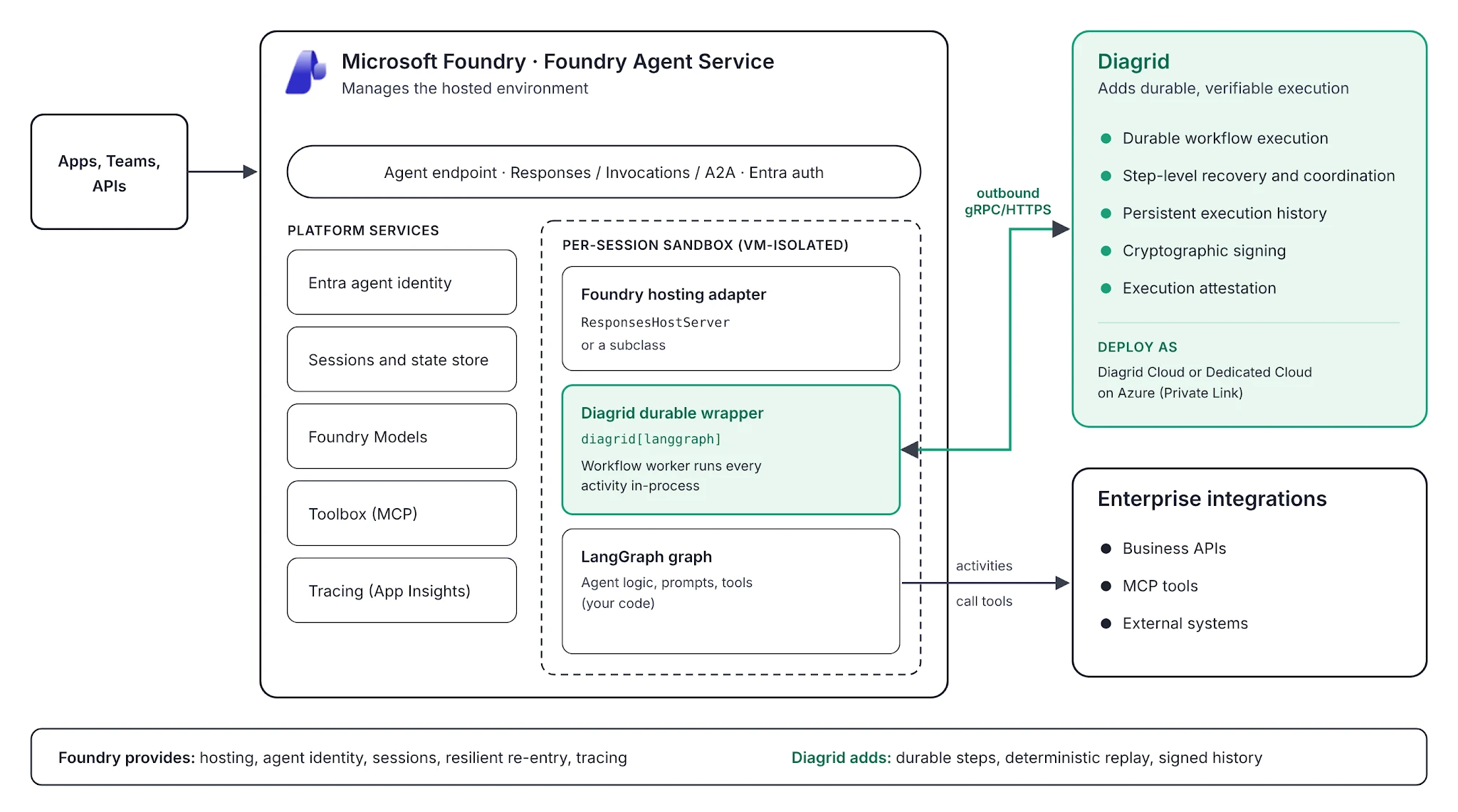
Figure 2. A LangGraph agent hosted in Foundry Agent Service, with Diagrid's durable wrapper running in the session sandbox.
Microsoft Foundry + Diagrid: better together
Consider a supplier-risk agent built using LangGraph and Microsoft Foundry.
The agent retrieves supplier records, analyzes risk using a Foundry model, places a procurement hold when necessary, and waits for human approval before proceeding.
Now imagine the agent crashes halfway through.
With Diagrid's durable execution, the workflow recovers using its persisted execution history. Completed data retrieval and model activities don't need to run again. Interrupted operations can be retried with appropriate idempotency protection, and the workflow can durably wait for approval because the wait is held by Diagrid as a durable event, not by a running worker. Foundry can release the session's compute while the agent waits, and the run picks up from the same step when the approval arrives.
Throughout that process, Diagrid's Verifiable Execution provides cryptographically signed evidence of the recorded execution steps and the workloads responsible.
On top of reliability and efficiency, Diagrid adds trust: signed execution histories provide independently verifiable evidence of what the agent did.
Build agents that finish. Prove what they did.
The next generation of enterprise AI won't be defined by intelligence alone.
It will be defined by agents that can execute reliably, survive failures, and provide trustworthy evidence of their actions.
Developers shouldn't have to build distributed systems infrastructure every time they deploy an agent. And enterprises shouldn't have to take an agent's execution history on faith.
Microsoft Foundry provides the foundation to build and run AI agents.
Diagrid provides the durable execution and cryptographic attestation that help make those agents production-ready.
Get started with Diagrid and Microsoft Foundry
Ready to make your Foundry agents durable and verifiable? Here's how to start:
- Try it free. Sign up for Diagrid Cloud and run the Foundry hosted-agent sample built with
diagrid[langgraph]. - See it live. Join Mark Fussell and Yaron Schneider in Dec to go deeper with Durable Execution on Azure with Diagrid including MS Foundry and AKS
- Request a technical deep dive with our team at diagrid.io/demo-request.
- Buy through Azure. Diagrid is available on Azure Marketplace and is MACC eligible, so it can count toward your existing Azure commitment.