
Diagrid/Dapr vs Camunda
Don't rely on a high-cost BPMN platform built around visual modeling, custom DSLs, and complex multi-service architecture. And stop paying for every workflow execution. Instead, choose a lightweight, code-first workflow engine, running as a Kubernetes-native sidecar, without the per-workflow tax.
Code-First Developer Experience
BPMN modeling, FEEL expressions, separate workers and connectors may work for analysts, but not for developers who want to move fast. Write durable workflows directly in your preferred programming language (Python, Java, Go, C#, etc.) using familiar SDKs. No BPMN diagrams or custom DSL required.
Dapr — Code-first workflow
A workflow in plain Python. Run it, test it, refactor it like any other function.
# Dapr Workflow — plain Python
@wf.workflow(name="order_workflow")
def order_workflow(ctx, order_id: str):
    payment = yield ctx.call_activity(
        charge_payment, input=order_id
    )
    if not payment.approved:
        return "rejected"

    yield ctx.call_activity(
        reserve_inventory, input=order_id
    )
    yield ctx.call_activity(
        ship_order, input=order_id
    )
    return "completed"
Camunda — BPMN XML DSL
The same workflow modeled in BPMN 2.0 XML, plus separate workers, FEEL expressions, and connectors.
<!-- Camunda BPMN 2.0 — XML DSL -->
<bpmn:process id="order_process" isExecutable="true">
  <bpmn:startEvent id="start"/>
  <bpmn:serviceTask id="charge_payment"
    camunda:type="external"
    camunda:topic="charge-payment"/>
  <bpmn:exclusiveGateway id="approved_gw"/>
  <bpmn:serviceTask id="reserve_inventory"
    camunda:type="external"
    camunda:topic="reserve-inventory"/>
  <bpmn:serviceTask id="ship_order"
    camunda:type="external"
    camunda:topic="ship-order"/>
  <bpmn:endEvent id="end"/>
  <!-- ... sequence flows, conditions, listeners ... -->
</bpmn:process>
<!-- + external job workers written in code
     + FEEL expressions for conditions
     + connectors for side effects -->
Better Pricing
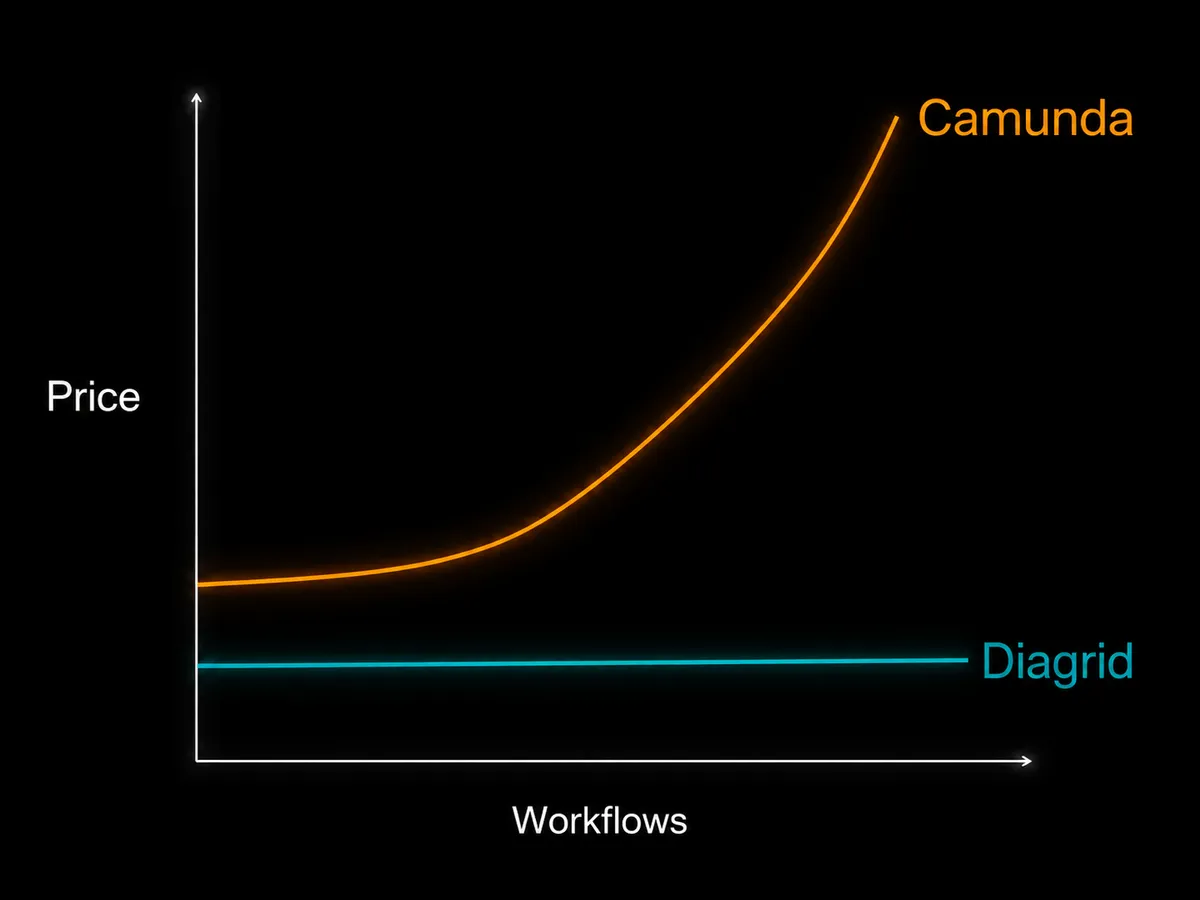
Why pay more every time a workflow runs? Ditch usage-based pricing and unpredictable bills. With Diagrid Catalyst (built on Dapr), you get a simple flat cluster license that includes unlimited workflow executions, unlimited non-production environments, and full enterprise support.
Lean & Efficient Architecture
Camunda relies on a heavyweight, multi-service architecture with complex central infrastructure and significant operational overhead. Dapr / Diagrid runs as a lightweight Kubernetes-native sidecar directly alongside your app in the same pod, eliminating central clusters. This design delivers simpler operations, significantly lower latency through fast inter-pod communication, and better fault isolation.
Dapr — Sidecar Architecture
One lightweight sidecar per pod. Workflow calls happen over localhost. Minimal Kubernetes footprint.
Camunda 8 — Heavyweight Multi-Service BPM Stack
Zeebe brokers, gateway, Operate, Tasklist, Optimize, Identity, and Elasticsearch — many services to install, operate, and license.
Enterprise Security
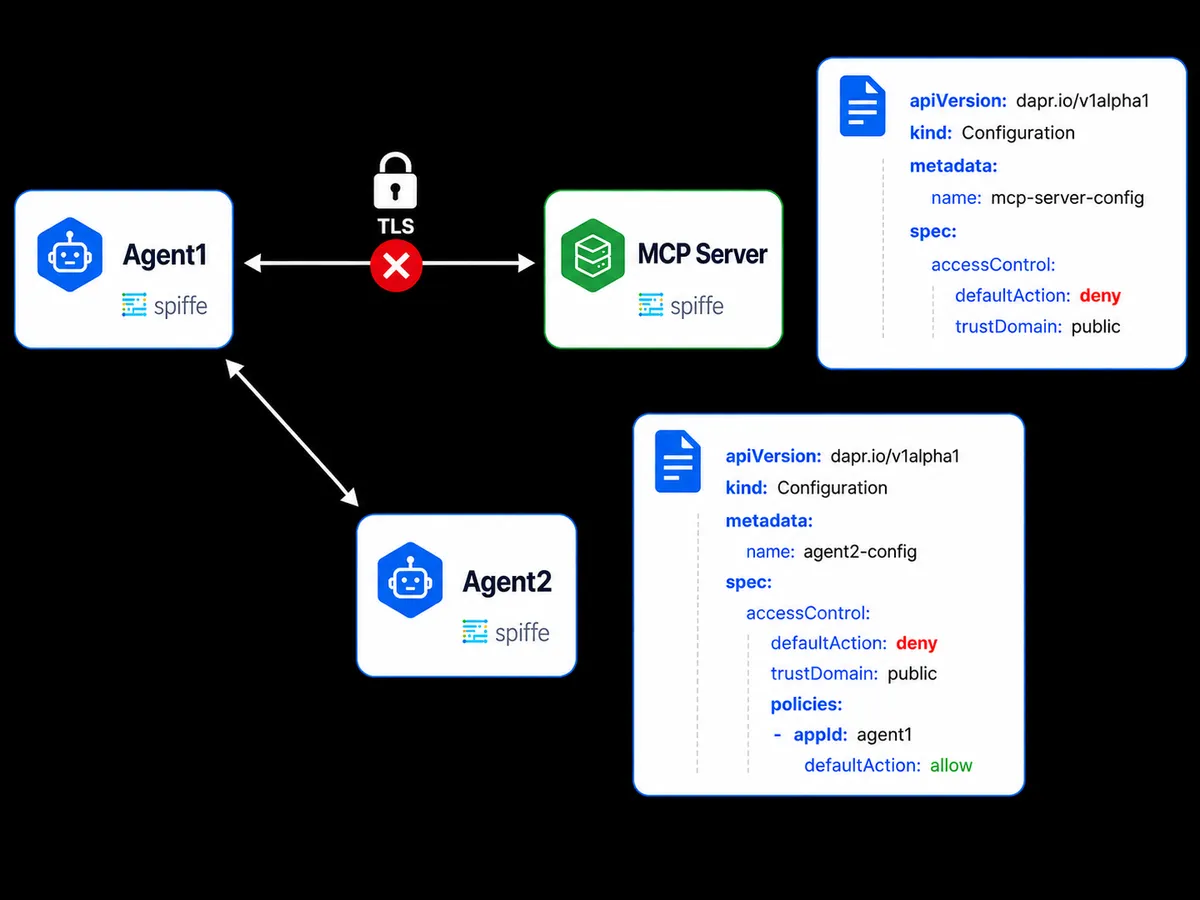
Diagrid Catalyst (built on Dapr) uniquely offers enterprise grade security every CISO needs as part of their AI security framework. Each AI agent is given a unique SPIFFE cryptographic identity with built-in mTLS and zero-trust policies offering identity, authorization and auditability in one elegant, lightweight solution.
Multi Agent Framework Support
Diagrid Catalyst (built on Dapr) integrates natively with the agent framework of your choice: LangGraph, CrewAI, Microsoft Agent Framework, Google ADK, OpenAI Agents, and more. No code rewrites required. Camunda does not provide any native agent framework integrations.
Diagrid Catalyst: Inherently secure & compliant
Camunda's managed offering runs in Camunda's infrastructure and meters you on every workflow execution. Diagrid Catalyst — the managed platform built on Dapr — gives you a fully managed experience while your data never leaves your network, and charges per instance of the runtime you deploy instead of per workflow execution.
Diagrid Catalyst — Self-hosted
All data stays within your corporate boundary, private and secure.
Camunda SaaS — Hosted
Workflow state, variables, and task payloads leave your network and are stored in Camunda's infrastructure.
Diagrid/Dapr vs Camunda: Feature-by-Feature
A quick reference comparing workflow orchestration capabilities, cost model, and operational footprint.
Durable Workflows
- Dapr OSS
- Camunda 8
- Diagrid Catalyst
- Camunda SaaS
Code-First Workflow Authoring
- Dapr OSS
- Camunda 8
- Diagrid Catalyst
- Camunda SaaS
No Custom DSL Required
- Dapr OSS
- Camunda 8
- Diagrid Catalyst
- Camunda SaaS
Pub/Sub Messaging
- Dapr OSS
- Camunda 8
- Diagrid Catalyst
- Camunda SaaS
State Management
- Dapr OSS
- Camunda 8
- Diagrid Catalyst
- Camunda SaaS
Service Invocation
- Dapr OSS
- Camunda 8
- Diagrid Catalyst
- Camunda SaaS
Actor Model
- Dapr OSS
- Camunda 8
- Diagrid Catalyst
- Camunda SaaS
AI Agent Frameworks
- Dapr OSS
- 8+
- Camunda 8
- 0
- Diagrid Catalyst
- 8+
- Camunda SaaS
- 0
Supported Databases
- Dapr OSS
- 15+
- Camunda 8
- Proprietary + ES
- Diagrid Catalyst
- 15+
- Camunda SaaS
- Managed
Pub/Sub Brokers
- Dapr OSS
- 14+
- Camunda 8
- Diagrid Catalyst
- 14+
- Camunda SaaS
Lightweight Infra (Sidecar)
- Dapr OSS
- Camunda 8
- Diagrid Catalyst
- Camunda SaaS
Kubernetes-Native
- Dapr OSS
- Camunda 8
- partial
- Diagrid Catalyst
- Camunda SaaS
- partial
Built-in mTLS
- Dapr OSS
- Camunda 8
- partial
- Diagrid Catalyst
- Camunda SaaS
Kubernetes Operator
- Dapr OSS
- Camunda 8
- partial
- Diagrid Catalyst
- Camunda SaaS
- (SaaS only)
Multi-Region Failover
- Dapr OSS
- Manual
- Camunda 8
- Manual
- Diagrid Catalyst
- Camunda SaaS
- (SaaS only)
CNCF Project
- Dapr OSS
- Camunda 8
- Diagrid Catalyst
- Based on Dapr
- Camunda SaaS
Multi-Vendor Backing
- Dapr OSS
- Camunda 8
- Diagrid Catalyst
- Based on Dapr
- Camunda SaaS
Free for Production Use
- Dapr OSS
- Camunda 8
- Diagrid Catalyst
- Free tier
- Camunda SaaS
Metered per Workflow Execution
- Dapr OSS
- Camunda 8
- Diagrid Catalyst
- Camunda SaaS
Priced per Runtime Instance
- Dapr OSS
- Camunda 8
- Diagrid Catalyst
- Camunda SaaS
Self-Hosted Data
- Dapr OSS
- Camunda 8
- Diagrid Catalyst
- Camunda SaaS
Data Privacy (On-Prem)
- Dapr OSS
- Camunda 8
- Diagrid Catalyst
- Camunda SaaS
RBAC
- Dapr OSS
- Camunda 8
- partial
- Diagrid Catalyst
- Camunda SaaS
SSO
- Dapr OSS
- Camunda 8
- partial
- Diagrid Catalyst
- Camunda SaaS
Audit Logs
- Dapr OSS
- Camunda 8
- partial
- Diagrid Catalyst
- Camunda SaaS
Cross-Cluster Service Discovery
- Dapr OSS
- Camunda 8
- Diagrid Catalyst
- Camunda SaaS
| Feature | Dapr OSS | Camunda 8 | Diagrid Catalyst | Camunda SaaS |
|---|---|---|---|---|
| Core | ||||
| Durable Workflows | ||||
| Code-First Workflow Authoring | ||||
| No Custom DSL Required | ||||
| Pub/Sub Messaging | ||||
| State Management | ||||
| Service Invocation | ||||
| Actor Model | ||||
| Ecosystem | ||||
| AI Agent Frameworks | 8+ | 0 | 8+ | 0 |
| Supported Databases | 15+ | Proprietary + ES | 15+ | Managed |
| Pub/Sub Brokers | 14+ | 14+ | ||
| Ops | ||||
| Lightweight Infra (Sidecar) | ||||
| Kubernetes-Native | partial | partial | ||
| Built-in mTLS | partial | |||
| Kubernetes Operator | partial | (SaaS only) | ||
| Multi-Region Failover | Manual | Manual | (SaaS only) | |
| Governance | ||||
| CNCF Project | Based on Dapr | |||
| Multi-Vendor Backing | Based on Dapr | |||
| Cost | ||||
| Free for Production Use | Free tier | |||
| Metered per Workflow Execution | ||||
| Priced per Runtime Instance | ||||
| Security & Privacy | ||||
| Self-Hosted Data | ||||
| Data Privacy (On-Prem) | ||||
| RBAC | partial | |||
| SSO | partial | |||
| Audit Logs | partial | |||
| Cross-Cluster Service Discovery | ||||
Frequently asked questions
Ready to ditch the DSL and high costs?
Start building with Catalyst in minutes. Code-first workflows, Kubernetes-native architecture, and a fully managed experience — priced per runtime, not per workflow execution.
