
Diagrid/Dapr vs Orkes Conductor
Both platforms orchestrate distributed workflows. Here's how they differ in architecture, developer experience, AI agent support, and operational footprint — so you can pick the right foundation for your apps and agents.
Code-First Developer Experience
Orkes workflows are defined in a JSON DSL that lives outside your application, with task workers registered separately. Dapr workflows are plain code in the language you already use. You run them, test them, and refactor them like any other function in your codebase.
Enterprise Security
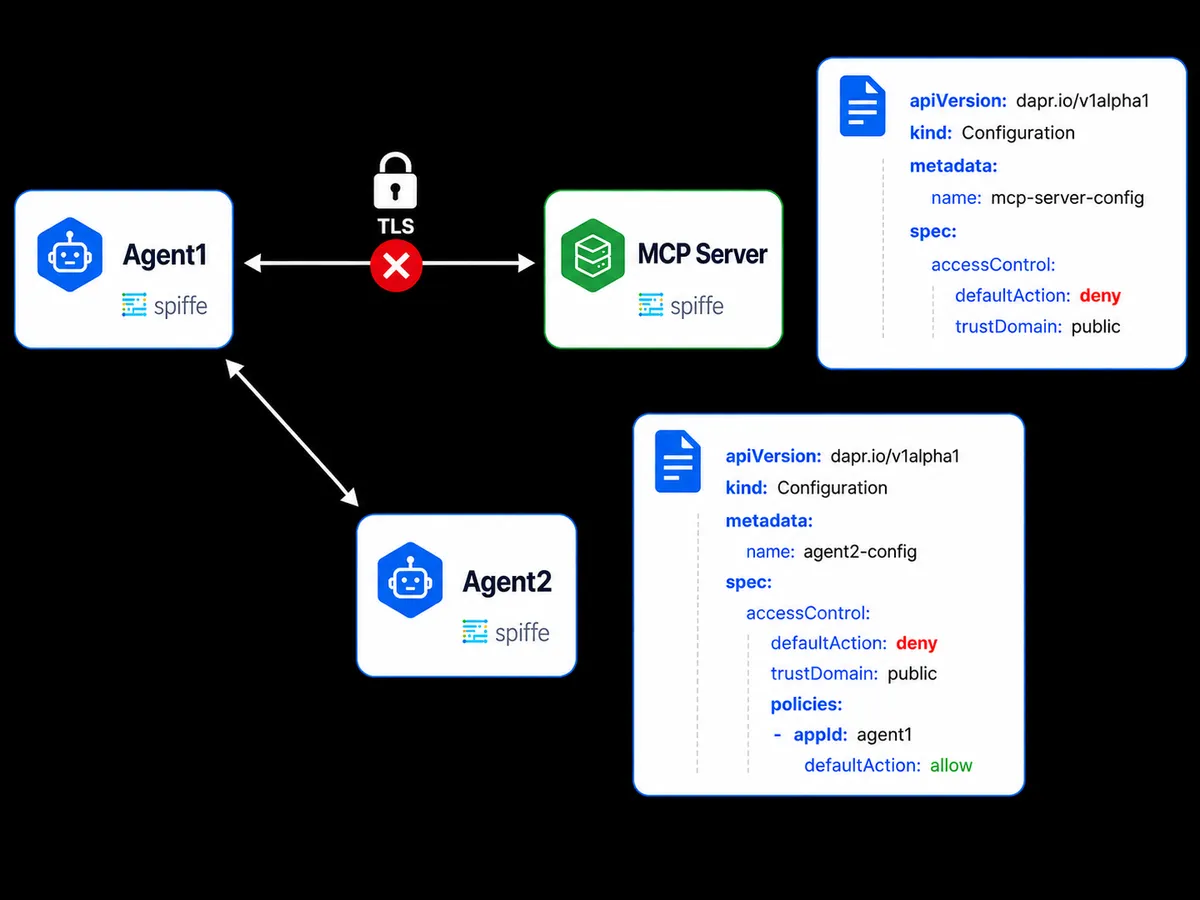
Diagrid Catalyst (built on Dapr) uniquely offers enterprise grade security every CISO needs as part of their AI security framework. Each AI agent is given a unique SPIFFE cryptographic identity with built-in mTLS and zero-trust policies offering identity, authorization and auditability in one elegant, lightweight solution.
Durable execution for
every AI agent framework
One of the biggest differences between Dapr and Orkes Conductor for AI workloads is framework support. With Dapr, you get durable execution that integrates natively with the agent frameworks your team already uses — no rewrites, no JSON-DSL glue code.
Orkes Conductor has no native integration with mainstream agent frameworks, forcing teams to hand-wire LLM calls and tool use into JSON workflow definitions.
Lightweight Architecture
Learn MoreDiagrid Catalyst (built on Dapr) runs as a lightweight sidecar alongside your application pods – no overhead, no heavyweight infrastructure, and less latency.
Dapr — Sidecar Architecture
Lightweight sidecars co-located with your app. Low latency, minimal infrastructure.
Orkes Conductor — Central Server Architecture
Workers poll a centralized Conductor server. Every workflow call is a network hop to the server cluster.
Data Sovereignty & Compliance
Learn MoreKeep all your sensitive data in your own VPC, not on Orkes' systems. Go one step further with a fully air-gapped deployment if you are in a regulated industry or run government workloads where outbound connectivity isn't an option.
Diagrid Catalyst — Self-hosted
All data stays within your corporate boundary, private and secure.
Orkes Cloud — SaaS default, BYOC available
The default Orkes-hosted SaaS sends workflow state to Orkes' infrastructure. A customer-hosted (BYOC) tier runs in your cloud account, but requires an enterprise agreement and ongoing Orkes coordination for upgrades.
Diagrid/Dapr vs Orkes Conductor: Feature-by-Feature
A quick reference comparing workflow orchestration capabilities across open-source and managed offerings.
Durable Workflows
- Dapr OSS
- Orkes Conductor OSS
- Diagrid Catalyst
- Orkes Cloud
Code-First Workflow Authoring
- Dapr OSS
- Orkes Conductor OSS
- Diagrid Catalyst
- Orkes Cloud
Pub/Sub Messaging
- Dapr OSS
- Orkes Conductor OSS
- Diagrid Catalyst
- Orkes Cloud
State Management
- Dapr OSS
- Orkes Conductor OSS
- Diagrid Catalyst
- Orkes Cloud
Service Invocation
- Dapr OSS
- Orkes Conductor OSS
- Diagrid Catalyst
- Orkes Cloud
Actor Model
- Dapr OSS
- Orkes Conductor OSS
- Diagrid Catalyst
- Orkes Cloud
AI Agent Frameworks
- Dapr OSS
- 8+
- Orkes Conductor OSS
- 0
- Diagrid Catalyst
- 8+
- Orkes Cloud
- 0
Supported Databases
- Dapr OSS
- 15+
- Orkes Conductor OSS
- 4
- Diagrid Catalyst
- 15+
- Orkes Cloud
- Managed
Pub/Sub Brokers
- Dapr OSS
- 14+
- Orkes Conductor OSS
- Diagrid Catalyst
- 14+
- Orkes Cloud
Lightweight Infra (Sidecar)
- Dapr OSS
- Orkes Conductor OSS
- Diagrid Catalyst
- Orkes Cloud
Built-in mTLS
- Dapr OSS
- Orkes Conductor OSS
- partial
- Diagrid Catalyst
- Orkes Cloud
Kubernetes Operator
- Dapr OSS
- Orkes Conductor OSS
- Diagrid Catalyst
- Orkes Cloud
Multi-Region Failover
- Dapr OSS
- Manual
- Orkes Conductor OSS
- Manual
- Diagrid Catalyst
- Orkes Cloud
- (SaaS only)
CNCF Project
- Dapr OSS
- Orkes Conductor OSS
- Diagrid Catalyst
- Based on Dapr
- Orkes Cloud
Multi-Vendor Backing
- Dapr OSS
- Orkes Conductor OSS
- Diagrid Catalyst
- Based on Dapr
- Orkes Cloud
Self-Hosted Data
- Dapr OSS
- Orkes Conductor OSS
- Diagrid Catalyst
- Orkes Cloud
- BYOC tier only
Data Privacy (On-Prem)
- Dapr OSS
- Orkes Conductor OSS
- Diagrid Catalyst
- Orkes Cloud
- Enterprise tier only
RBAC
- Dapr OSS
- Orkes Conductor OSS
- partial
- Diagrid Catalyst
- Orkes Cloud
SSO
- Dapr OSS
- Orkes Conductor OSS
- Diagrid Catalyst
- Orkes Cloud
Audit Logs
- Dapr OSS
- Orkes Conductor OSS
- Diagrid Catalyst
- Orkes Cloud
Cross-Cluster Service Discovery
- Dapr OSS
- Orkes Conductor OSS
- Diagrid Catalyst
- Orkes Cloud
| Feature | Dapr OSS | Orkes Conductor OSS | Diagrid Catalyst | Orkes Cloud |
|---|---|---|---|---|
| Core | ||||
| Durable Workflows | ||||
| Code-First Workflow Authoring | ||||
| Pub/Sub Messaging | ||||
| State Management | ||||
| Service Invocation | ||||
| Actor Model | ||||
| Ecosystem | ||||
| AI Agent Frameworks | 8+ | 0 | 8+ | 0 |
| Supported Databases | 15+ | 4 | 15+ | Managed |
| Pub/Sub Brokers | 14+ | 14+ | ||
| Ops | ||||
| Lightweight Infra (Sidecar) | ||||
| Built-in mTLS | partial | |||
| Kubernetes Operator | ||||
| Multi-Region Failover | Manual | Manual | (SaaS only) | |
| Governance | ||||
| CNCF Project | Based on Dapr | |||
| Multi-Vendor Backing | Based on Dapr | |||
| Security & Privacy | ||||
| Self-Hosted Data | BYOC tier only | |||
| Data Privacy (On-Prem) | Enterprise tier only | |||
| RBAC | partial | |||
| SSO | ||||
| Audit Logs | ||||
| Cross-Cluster Service Discovery | ||||
Frequently asked questions
Ready to see the difference?
Start building with Catalyst in minutes. Keep your AI framework, your data, and your infrastructure — just add code-first durable execution.
