How Synergy Logistics Built Autonomous Warehouse Agents with Diagrid Catalyst
Synergy Logistics built a multi-agent system on Diagrid Catalyst and Dapr Agents that takes on routine warehouse supervision — surfacing at-risk orders and predicting stockouts while running inference on its own infrastructure.

Company Background
Synergy Logistics is a global leader in the software known as Warehouse Management Systems (WMS) and is used by warehouses all over the world, supplying everything from pet food, to vacuum cleaners. Its platform coordinates the core flow of warehouse work where orders are picked, packed, and shipped with various carrier partners across customer sites in multiple geographies.
The team set out on a greenfield initiative to explore where AI agents could take on real-time operational decisions traditionally made by a warehouse supervisor, reducing the overhead on operators and improving KPIs like the numbers of orders at risk of missing their shipping deadline or predicting upcoming shipment stockouts.
Business Case for Agents
Warehouse supervision is a 24/7 responsibility. A single warehouse operator's salary is roughly $75k plus overhead, and round-the-clock coverage can total up to approximately $400k per year. Synergy estimated that an autonomous AI agent could handle up to 75% of routine operator scenarios creating a clear path to scale operations with less overhead and cost.
Cost was not the only driver. Synergy also wanted to:
- Explore concrete agent use cases such as surfacing at risk orders, predicting stockouts and optimizing task prioritization.
- Modernize and optimize by enabling more application patterns using a familiar programming approach while retaining full visibility into how the agents behave.
- Strengthen operator and developer agility without sacrificing warehouse control or losing clarity.
Why Diagrid Catalyst and Dapr
When defining the stack for its agentic workloads, Synergy was already invested in the Dapr programming model and wanted to carry it forward rather than adopt an unfamiliar abstraction. The engineering team builds primarily on a .NET stack, so evaluated the Microsoft Agent Framework (MAF) initially, but standardized on Dapr Agents, a python open source agentic framework, for the implementation given it is layered on the Dapr APIs the team already knew.
Diagrid Catalyst Enterprise was selected as the hosting platform. Key factors in the decision included:
- Managed agents platform: Catalyst provides a managed agents platform, reducing the operational burden of running agentic infrastructure and storage while keeping deployments within Synergy's infrastructure boundary.
- Developer productivity: The team could build agents using the familiar Dapr APIs and local tooling (Aspire, Azure DevOps) they already used day to day.
- Agent and visibility: Catalyst surfaces workflow history and agent execution, giving the team insight into agent behavior, a non-negotiable requirement for putting agents near live warehouse operations.
- Private cloud environment: Catalyst runs on Synergy's on-premises Kubernetes private cloud estate and integrates with the team's Azure ecosystem and .NET stack.
AI Agents for Warehouse Operations
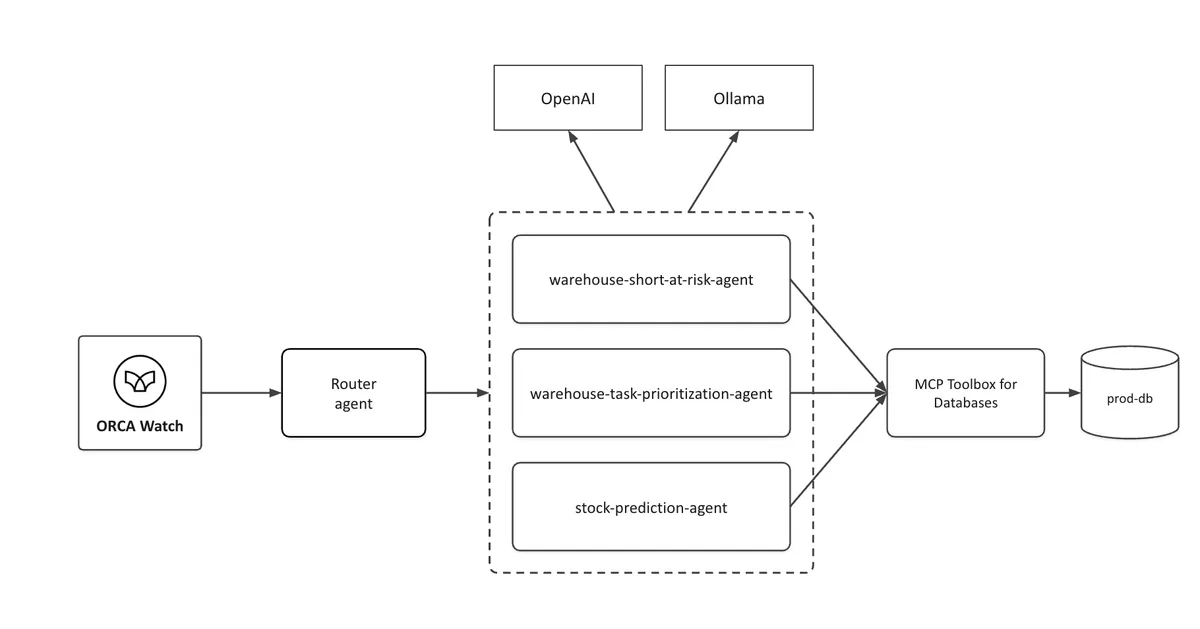
Synergy built a multi-agent application on Catalyst and Dapr Agents that mirrors how a warehouse supervisor reasons about the day's work. The design uses four agents: one orchestrator agent and three core-function agents, each responsible for a distinct slice of warehouse decision-making business logic.
How It Works
The agents reason over Synergy's WMS data model including shipments (customer orders), receipts (inbound purchase orders), stock totals, and stock movements (pick, put-away, and replenishment tasks). Rather than wiring the agents directly to the database, the team exposed this SQLServer data through an MCP server, giving the agents a structured, governed way to query live operational state.
- Orchestrator Agent: the single entry point that coordinates the business-logic agents and assembles their output for the user.
- Short At-Risk Agent: identifies shipments at risk of missing their order deadline, flags shipment shortages, and distinguishes shipments with and without incoming receipts, summarizing them in easily readable, pie-chart visualizations.
- Task Prioritization Agent: focuses on at-risk shipments without stock shortages, that have operator pick and replenishment tasks available. Updates the priority of these tasks to get at-risk shipments shipped out before carrier cutoff times and drives customer-service notifications when the cutoff time has passed.
- Stockout Prediction Agent: identifies predicted stockouts over the coming month, accounting for incoming stock receipts and high-volume SKUs.
Operators interact through a chat-based UI that renders dashboard visualizations turning natural-language questions into an at-a-glance operational view. For operationalization, the agents would be running on a monthly schedule as well, producing reports for warehouse managers to review as needed.
Agent Models
Data residency was a hard constraint for Synergy under GDPR, so no customer-specific data could leave the private cloud site. To move quickly during the build, the team began with a hosted OpenAI model to validate agent behavior, then migrated inference to a self-hosted Ollama model running inside Synergy's own environment. This kept sensitive warehouse and customer data on-site while preserving the agent design unchanged and showcased the value that a model-agnostic agent layer such as Dapr Agents provides.
Agent Durability
Dapr Agents framework builds on Dapr's durable primitives, specifically the Workflow API, so agent orchestration benefits from the durable-execution foundations rather than the bespoke retry logic relied upon by other agent frameworks. Dapr Agents runs every agent execution as a workflow, allowing agents to recover from where they left off if they fail, and checkpointing/replaying the workflow state along the way. Due to the abstraction layer provided by Dapr, the choice of the append-only state store is left up to the user, in Synergy's case, PostgreSQL was used.
Agent Observability
Diagrid Catalyst provided production-level operational visibility on top of the multi-agent system. The detailed workflow visualizer gave the team a way to see what each agent execution did and why, giving essential visibility into the calls made to the tools, LLMs and output to the end user. Catalyst provided an essential piece of trusting agents to operate alongside live warehouse operations data ensuring that the agents only had access to the correct resources, being able to view audit logs on the agents behaviour and troubleshooting any issues that they were having.
“What stood out was how quickly we went from an idea to agents our team could trust. Dapr and Catalyst let our developers work in a model they already knew, and we kept full visibility into what every agent was doing - right down to running inference on our own infrastructure so nothing left the site. We proved we could take real supervisory decisions and put them in front of an agent, without losing control or clarity.”
— Smitha Raphael, Project Management Lead, Synergy Logistics
Lessons Learned
- Bring agents to a programming model your team already trusts. By building on Dapr Agents and Catalyst, Synergy's developers worked in a familiar model and moved from concept to validated agents with a lower barrier of entry.
- Mirror your business process in the agent design. An orchestrator plus three focused business-logic agents mapped directly onto how a supervisor reasons about at-risk orders, task priority, and stockouts, making the system intuitive to extend and to reason about.
- Govern data access through an MCP layer. Exposing the WMS database via an MCP server gave the agents a structured, controlled path to live operational state instead of ad-hoc database wiring. Access control lists on the MCP server by Diagrid Catalyst provided an additional security layer.
- A model-agnostic agent layer protects data residency while maintaining flexibility. Starting on a hosted model for speed and migrating to self-hosted Ollama on-site with no code changes let Synergy meet compliance standards without slowing the development lifecycle.
- Observability and reliability make agents trustworthy near live operations. Diagrid Catalyst brought essential agent durability and visibility into the execution history allowing the team to put agent decisions next to live warehouse work without worrying about dangerous hallucinations.
What's Next
Additional agentic use cases and next steps for Synergy's modernized warehouse operations suite:
- Labor management use case: Infer how many pickers and packers are needed based on the current volumes and workload. For extremely quick pickers and packers, take their yields into consideration when estimating the workforce.
- Stockout prediction improvements: Incorporating commercial, operational, and local drivers (product launches, local events, supplier delays), and ultimately a foundation time-series model to improve forecast accuracy and uncertainty estimation.
- Production readiness: agent-data multi-tenancy for multiple warehouse deployments, implementing a testing framework, agent benchmarking for scalability, and the migration of the orchestrator agent pattern to a more scalable agents-as-tools architecture.
Strategic Insights
Synergy's engagement points to a broader shift in how enterprises can approach operating autonomous agents. The barrier to putting agents next to live, revenue-critical systems has never been model capability, but trust. Synergy's experience shows that trust comes from the foundations around the model, namely durable execution, end-to-end observability, and governed data access. Enterprises that treat these as first-class requirements move from experiment to operational decision-making far faster than those chasing raw model performance.
Agentic modernization also does not require re-platforming. By using Dapr Agents, Synergy adopted autonomous agents inside a programming model its developers already knew, rather than committing to an unfamiliar abstraction. For an enterprise with an established stack and limited risk-appetite, extending what teams already trust lowers the barrier to entry, shortens the path from concept to deployed system, and keeps institutional knowledge intact.
Finally, the model migration showcases that data residency and shifting requirements need not delay AI adoption. The model-agnostic agent layer provided by Dapr Agents let Synergy validate the solution quickly using a hosted model, then move inference fully on-site with no change to the application code. Enterprises facing GDPR or sovereignty requirements do not need to choose between speed and compliance; the right architecture delivers both while preserving the freedom to change models as the landscape evolves.
Additional Resources
- Diagrid Catalyst AI Agent Orchestration Platform: https://www.diagrid.io/catalyst
- Dapr Agents overview: https://docs.dapr.io/developing-ai/dapr-agents/
- Dapr Workflow overview: https://docs.dapr.io/developing-applications/building-blocks/workflow/workflow-overview/
Ready to get started?
See how Diagrid can help you run Dapr in production with confidence.