
Data Governance for AI Agents
Teams want to ship AI agents quickly, but governing them often creates a trade-off between speed and control. This piece explores how to maintain control while quickly deploying AI agents at scale.
Today, AI agents query databases, access enterprise data, and make decisions based on it. However, as AI agents become more sophisticated and widely adopted, data governance becomes a critical concern.
This is especially important because teams want to deploy AI agents quickly, but their existing governance processes do not allow it. Their processes contain manual approvals, fragmented policies, and inconsistent controls, which slow deployment and still leave security and compliance gaps.
The central question is how organizations can deploy AI agents quickly at scale without compromising security, compliance, or control.
The answer begins with effective data governance. By the end of this piece, you will understand what data governance for AI agents means and how to govern AI agents securely, consistently, and at scale.
What data governance means for AI agents
Data governance for AI agents refers to the set of policies, controls, and processes that define how autonomous agents access, use, and act upon organizational data.
It determines which data an AI agent can interact with, under what conditions it can access that data, and how its actions are monitored and constrained across systems.
AI agents actively interact with data rather than just consuming it. They query databases, access APIs, use enterprise tools, and make decisions based on the retrieved data. This shifts governance toward how agents access and use data.
Below are the key areas of data governance:
- Data quality ensures that agents operate using accurate and reliable data.
- Metadata management provides context about data sources and their usage.
- Access control governs permissions and prevents unauthorized access to data.
- Data retention and handling governs how data is stored and managed over time based on policy and compliance requirements.
Effective data governance reduces the risk of data leakage, supports regulatory compliance, and ensures that sensitive data is neither exposed nor misused by AI agents.
As AI decision-making processes are often opaque, ensuring transparency and accountability is a significant challenge. AI agents depend on large, diverse training datasets that may contain sensitive or biased information. The inability to effectively govern this data can increase the risk of unintended results.
In this context, data governance is essential for ensuring the security, compliance, trust, and accountability of AI agents.
Why traditional governance frameworks struggle with AI agents
Traditional governance frameworks are designed for rule-based systems with fixed data flows and predefined access patterns. AI agents do not behave this way. They operate autonomously, adapt at runtime, and make decisions and take actions across systems in ways that are not fully known at design time.
These characteristics of AI agents are what make traditional governance frameworks difficult to apply.
Agents have dynamic access patterns
AI agents do not always follow the same fixed route to access data. They choose different data sources and steps depending on context, task requirements, and runtime conditions.
This creates the following challenges:
- Dynamic data access paths. Traditional governance frameworks work well with systems with defined pipelines and structured schemas. However, AI agents determine at runtime which data sources and tools to use based on the current execution state.
- Human-in-the-loop latency. In traditional systems, a request is reviewed and approved before moving to the next step. In AI agents, a single request can trigger multiple internal steps, each involving tool calls and data retrieval steps. Requiring human approval at every step adds latency and degrades AI agents autonomy.
Agents can take actions, not just generate outputs
Traditional governance frameworks are designed for systems that generate outputs rather than execute actions. Typically, a system produces results, and humans or downstream services decide what to do next.
AI agents eliminate this separation. They can update records, create tickets, trigger workflows, and send messages across enterprise systems.
This means AI agents are now active participants in operational systems. They do not just generate outputs that can wait for review. They execute actions that have an immediate impact on enterprise systems. And the governance must extend to the actions themselves, as they have direct consequences.
Agent behavior evolves over time
AI agents make decisions at runtime and adapt to changing conditions. Their behavior can evolve after deployment. This introduces new governance challenges because agent behavior is no longer fixed or fully predictable once the system is in production.
Their behavior can be affected by changes in prompts, changes in tools, and changes in available data. As these inputs shift, the way agents perform tasks and select actions can also change.
AI agents use real-time learned patterns to decide actions, which makes their decisions harder to interpret and audit. As a result, ensuring safe, fair, and ethical behavior becomes more complex, especially when human oversight is not always available.
These characteristics require governance frameworks to evolve. Static controls cannot adequately address autonomous, adaptive, and continuously changing agent behavior in real-world environments.
The five pillars of data governance for AI agents
Effective governance of AI agents is built on five interconnected pillars. Each pillar represents a critical control area with specific practices that help ensure secure and reliable system behavior.
Below are the five pillars of data governance for AI agents:
1. Access governance
Access governance defines the data, tools, and actions that an AI agent is authorized to use during execution.
AI agents make decisions at runtime about which systems to access and which actions to take. Their access patterns are dynamic, and a single task can trigger multiple tool calls, API requests, and data retrieval operations. This makes static approvals insufficient.
Access governance requires clearly defined operational boundaries within which an agent can act.
These boundaries include:
- Defining the data sources that an agent can access.
- Controlling the tools and services an agent is permitted to use.
- Restricting, permitting, or prohibiting specific actions that an agent can perform.
- Defining how agent identity relates to user identity for access control and accountability.
To enforce these boundaries, organizations rely on several key controls:
- Identity and authentication to establish a verifiable agent identity and link actions back to the initiating user.
- Authorization policies to evaluate data access requests, tool invocations, and actions at runtime.
- Role-based access controls (RBAC) to define permitted capabilities.
- Least-privilege principles to grant agents only the minimum access required to complete a task.
These controls are essential for enforcing governance in dynamic agent environments.
2. Data quality and provenance
AI agents operate across multiple systems, interpret context dynamically, and depend on data consistency to reason accurately. Therefore, data quality is a key factor for reliable agent behavior.
With low-quality data, AI agents do not always fail in obvious ways. They generate results that seem plausible but are actually incorrect.
Effective data quality governance in AI agent environments requires:
- Consistent definitions of data across systems, ensuring the same fields carry the same meaning wherever agents operate.
- Complete and well-understood datasets, with explicit handling of missing or partial information.
- Clear data structures, labeling, and metadata, enabling agents to accurately interpret context, relationships, and priorities.
- Data classification and validation rules that ensure data is accurate, usable, and handled appropriately based on its sensitivity and intended purpose.
- Defined accessibility rules that ensure agents can consistently retrieve data within acceptable latency and availability thresholds.
Data provenance is crucial for ensuring trust and accountability. Every data point used by an AI agent must be both explainable and traceable.
This requires the following:
- Clear data lineage across systems, transformations, and integrations.
- Traceability of data inputs used in agent decisions and outputs.
- Documentation of source systems to ensure that data originates from known and trusted enterprise environments.
Before deploying an agent, the underlying data should be audited, including both its quality and provenance. Any weaknesses must be identified and addressed. And data quality checks should be embedded into pipelines from the beginning.
3. Policy enforcement and guardrails
As AI agents perform actions across tools, data systems, and external services, governance must shift from static approvals to continuous guardrails applied during execution rather than before it.
Traditional governance controls rely on predefined checks or documentation, but AI agents require enforcement mechanisms that monitor behavior in real-time.
Most current systems embed policy enforcement within the same agent environment using middleware or application-level checks. This can prevent many unsafe actions, but it is limited because enforcement operates within the same process boundary, memory space, and execution context as the agent it is meant to control.
As a result, the agent and the control layer are not completely independent. If execution occurs outside the middleware, the system cannot independently confirm what actually happened.
Stronger guardrails, therefore, require independent runtime observation outside the agent's execution environment. This involves capturing actual system behavior such as execution paths, network activity, and data movement.
This approach enables governance through guardrails rather than gates. Guardrails do not just block actions at a single point. They observe, constrain, and validate behavior throughout execution. This ensures that policies are enforced in practice.
4. Observability and auditability
Security teams may know that policy controls are applied during agent runtime. But they may still not comprehend why a particular output was generated or how those controls influenced the outcome in context.
Alongside policy enforcement, governance requires observability at the AI agent runtime layer. This is to provide visibility into agent behavior and support accountability in accordance with regulatory expectations.
Visibility comes from runtime mechanisms such as logging, distributed tracing, and execution records that capture how an agent behaves as it operates. These signals reconstruct what actually happens during execution rather than only what policy defines as intended behavior.
Regulatory frameworks, such as the EU AI Act and emerging AI governance standards, place increasing emphasis on traceability and accountability. It is no longer sufficient to say that controls exist. Organizations must be able to prove that these controls have been consistently enforced over time.
This requires a comprehensive audit trail of agent activities, including data accessed, tools invoked, actions performed, and decisions made.
Each AI interaction, policy evaluation, and enforcement action should be documented in a structured and defensible format. This approach enables compliance and security teams to investigate incidents, respond to audits, and support internal reviews without relying on fragmented system logs.
5. Continuous monitoring
Observability improves organizations' understanding of how their AI systems behave in production environments.
However, certain governance needs for AI agents cannot be addressed by observability and policy enforcement alone, as some vulnerabilities or exploitation patterns are not visible through execution traces.
Continuous monitoring involves actively looking for governance violations and abnormal patterns in agent activity. This includes monitoring for unauthorized access attempts, suspicious behavior, policy violations, and broader operational anomalies that may indicate misuse or emerging risks.
Agentic fingerprints are particularly important in this context. They provide a traceable record of how an agentic attack unfolds over multiple turns, capturing decision paths, behavioral shifts, and tool usage. This enables security teams to understand not only that a vulnerability was exploited but also how and why it occurred.
Insights from continuous monitoring can be translated into guardrails, with observability data validating how those controls perform in production. This creates continuous feedback loops that refine the guardrails over time.
These feedback loops enable organizations to apply alerting, conduct incident investigations, and update policies collaboratively. They strengthen governance and reduce the likelihood of recurring issues.
How Diagrid enables governance at the infrastructure layer
AI agents require runtime governance controls capable of monitoring execution in real-time and implementing safeguards before high-risk actions are executed. They also need traceability across distributed workflows and reliable audit trails.
For these requirements, governance is most effective when embedded directly into the infrastructure layer. Diagrid Catalyst runs within your existing infrastructure, including public cloud environments such as AWS, Azure, and GCP, as well as on-premises deployments.
Diagrid Catalyst is built on top of Dapr, a graduated cloud native computing foundation (CNCF) project designed for building distributed applications, workflows, and AI agents. It is adopted by thousands of organizations across the world.
Here's how Diagrid Catalyst enables governance at the infrastructure level:
Governance and compliance at the infrastructure layer
Diagrid Catalyst provides the runtime foundation for production AI systems. It includes real-time observability, durable execution, secure identity, and operational controls that support governance at scale.
These capabilities align with governance and compliance requirements defined in frameworks such as the NIST AI risk management framework (RMF) and ISO/IEC 42001. Both frameworks emphasize lifecycle risk management, monitoring, traceability, and accountability.
They also enable logging, oversight, and record-keeping necessary to meet EU AI Act requirements.
Enforcing policy and access at runtime
Catalyst separates configuration from execution by using a control plane and a data plane. The control plane defines policies, App IDs, and system components, while the data plane enforces these policies during runtime.
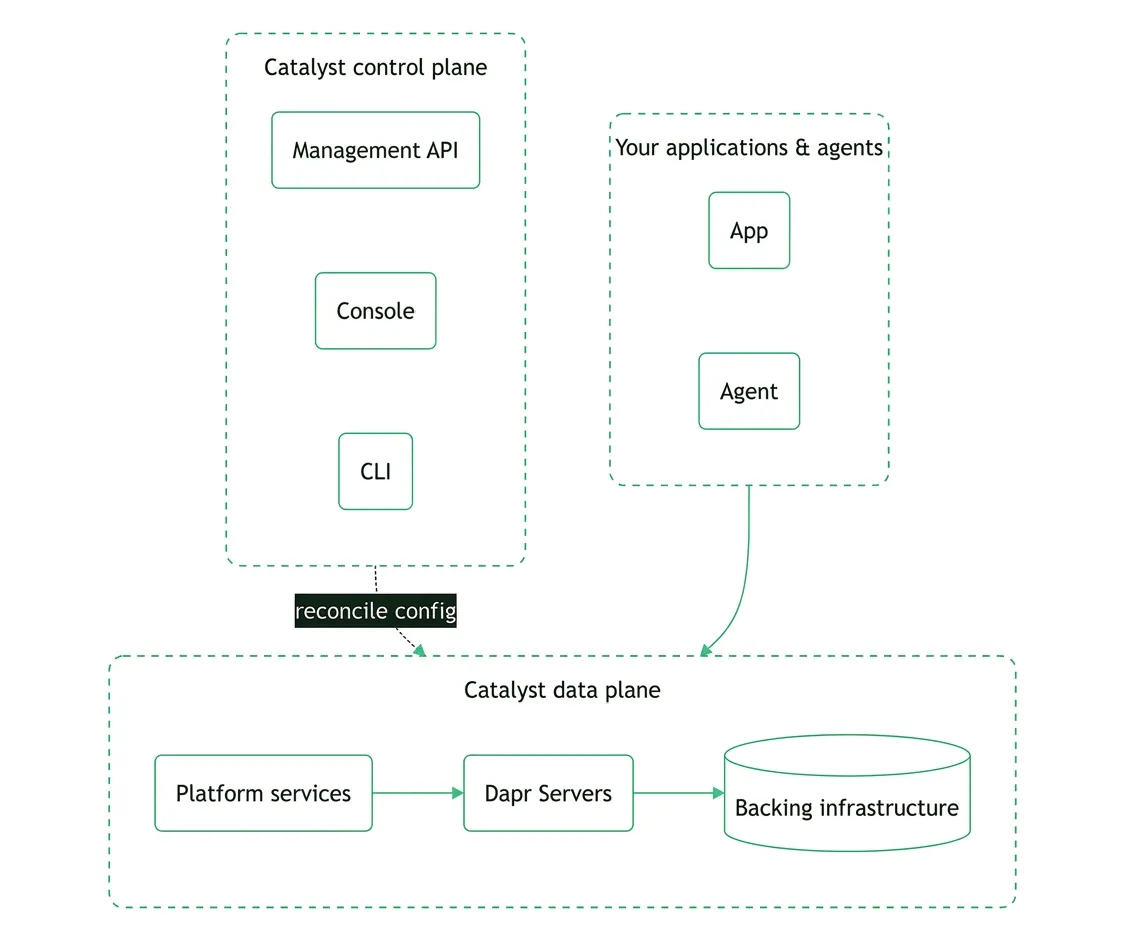
Fig: Catalyst's architecture separating control plane configuration from data plane execution
App IDs define an application's identity within a project and determine how policies are applied at runtime. Catalyst provides a declarative policy model using YAML manifests that the data plane interprets natively. When an agent sends a request via Catalyst, the relevant policies are applied before it reaches the target service.
These policies govern access to services and components. They also manage runtime behaviors such as resiliency and operational configuration, all without requiring changes to the application code.
Catalyst also provides workload identity through App ID tokens at the gateway. Workloads within the data plane are represented using SPIFFE-based identities. They communicate over mutual TLS, enabling secure authentication across services and infrastructure without shared secrets.
At runtime, access rules defined at the App ID level are enforced by the data plane. This ensures that workloads interact only with approved services while maintaining auditable, policy-driven execution.
End-to-end visibility and auditability
Diagrid Catalyst provides end-to-end observability for AI agents through metrics, distributed traces, and structured logs. These signals are generated for every agent run, workflow, and API call.
As execution occurs in the data plane, these signals are generated automatically during runtime. This means visibility is created as part of execution rather than being added afterward. Teams gain insights into agent behavior without the need for manual instrumentation or custom logging.
Metrics are continuously generated as agents execute, reflecting how agents behave over time. These metrics include run frequency, error rates, and latency across tool calls and workflows. Distributed traces track each request across services and tools, revealing decision paths and pinpointing points of delay or failure. Logs capture inputs, outputs, and results at every step, enabling a detailed review of agent actions.
These signals enable teams to track, debug, and correlate every action an agent takes with the underlying services and components it interacts with.
Building governance systems on top
Catalyst provides the runtime foundation for AI agent governance. Its built-in identity management, policy enforcement, and observability give platform teams control during execution, where agent behavior actually occurs.
These native capabilities enable organizations to implement comprehensive governance frameworks using the platform as a foundational layer. Catalyst's durable workflows ensure reliable execution of long-running and failure-prone agent operations in production environments.
Catalyst can also be integrated with an organization's existing security and governance systems, enhancing operational control, visibility, and monitoring across complex environments.
Where to go next
This piece introduced the core concepts of data governance for AI agents in production systems. It focused on the controls, visibility, and operational foundations needed to deploy agents safely at scale.
However, governance represents a broader layer of the challenge. Once you understand how to govern agent behavior, the next step is to secure the AI agents themselves.
The next stages of this series will explore agent security in depth. They will cover agent identity, authentication and authorization models, common threat models, emerging attack vectors, and the controls necessary to protect agentic systems in production.
To learn more, explore the resources below:
