
Common Failure Modes in Production Agents
Agents excel in demos because they run under controlled conditions. Production environments expose them to failures that require durable execution. This piece breaks down the common failure modes and explains how Diagrid Catalyst helps prevent them.
AI agents face a different class of challenges as soon as they interact with real users, real data, and real systems. The same agents that perform well in notebooks start to fail once they face the unpredictability of production environments.
Tools may fail, time out, or return partial results. Multiple agents write to a shared state simultaneously, causing conflicting updates and an inconsistent workflow state. And users rarely follow the expected interaction flow. These are recurring production challenges that every production agent must withstand.
Why do these failures occur, and what does it take to make agents production-ready?
By the end of this piece, you will understand the common failure modes in production agents and how Diagrid Catalyst prevents them through persistent state, durable execution, security, and governance.
Why AI agents work in demos but fail in production
An agent can deliver an excellent demonstration yet still be miles away from production readiness. During your demo, you control the inputs, having tested the exact questions the agent will receive. You also know which tools it will call and what responses it will generate.
The difference lies in the environment. Production environments are far less predictable than demo environments. They give you:
- Unreliable external systems where tools fail, time out, or return partial results.
- Concurrent execution involving multiple agents writing to a shared state simultaneously.
- Context and token limits as reasoning chains become longer and more complex.
- Unpredictable user behavior that deviates from the expected interaction flow.
These are not edge cases. They are the problems you must solve to keep agents operational in production. Your demo agent has never experienced failure, but production agents fail constantly.
Five most common production agent failure modes
The following failure modes represent the most common challenges teams face when moving AI agents from controlled environments into production.
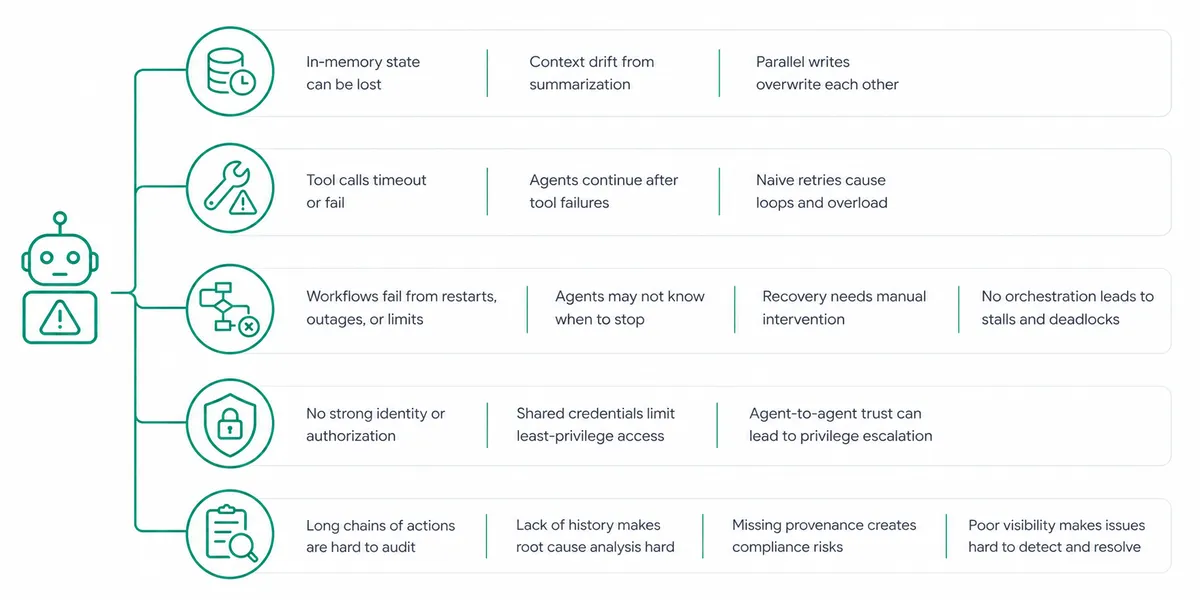
Fig 1: Production truth is wider and messier than a demo.
State loss and context drift
Many agentic frameworks let you re-run a workflow from a specific task, but they often retain only the latest execution state with no historical record. When a workflow state exists only in memory, a process crash or infrastructure failure discards its progress. The agent cannot resume from where it left off and often has to restart the entire workflow.
Even when the workflow continues uninterrupted, long running tasks present a different challenge. When you chain three or more agents, each one receives a compressed or summarized version of what the previous one produced. As these summarized outputs are passed between reasoning steps, each handoff can introduce subtle drift from the original task. Over time, the workflow begins operating on stale or incomplete context. By step six of a ten step workflow, it may produce outputs that sound plausible but no longer align with the user's original request.
There are risks with parallel execution as well. When multiple agents write to the same shared state without isolated write scopes, they can overwrite each other's work and produce internally inconsistent outputs.
Tool failures and recovery loops
Agents depend on external tools and APIs to complete tasks. However, these dependencies introduce failure points. Tool calls can timeout, return partial results, fail with errors, or produce malformed responses. Agents may continue reasoning after a tool failure instead of stopping, which can lead to incorrect outputs.
Tool call failures also create recovery challenges. Naive retry logic triggers repeated calls without addressing the underlying issue. A transient API failure can quickly turn into a retry loop that increases latency and consumes unnecessary tokens. Without built-in recovery mechanisms, developers often have to manually handle retries, fallback logic, and workflow continuation.
Workflow interruptions and coordination failures
Production agents often execute long-running workflows that span multiple steps, tools, and reasoning cycles. These workflows can fail midway when the underlying infrastructure changes or encounters failures. A pod restart, deployment, rate limit, or temporary database outage can interrupt execution and leave the workflow in an incomplete state.
This challenge becomes worse as many agents are designed to complete tasks rather than recognize when they should stop. Without clear confidence thresholds and escalation paths, agents continue with a low-confidence response instead of requesting human review.
And recovering from these failures often requires manual intervention. Teams have to determine where the workflow stopped, identify which steps completed successfully, and restart execution from that point. And many agents are not designed for this human involvement as it requires the agents to be capable of pausing for approvals, preserving their current state, and safely resume once a decision is made.
Along with this there is no reliable orchestration for multiple agents running simultaneously to coordinate progress and prevent conflicts. Without proper execution guarantees, workflows can stall, deadlock, or fail to complete because one component is waiting on another unfinished step.
Unauthorized agent actions
Production agents often perform privileged actions such as calling APIs, accessing databases, invoking tools, or communicating with other agents. Without strong identity and authorization controls, agents may execute actions beyond their intended permissions. There is no reliable way to verify who the agent is, what it is allowed to do, or what actions it has performed.
Many agent frameworks still rely on shared credentials, such as API keys stored in environment variables. This approach treats agents as anonymous processes and makes it difficult to enforce least-privilege access. A credential grants access to a resource, but it cannot verify whether the specific agent or workflow step user was authorized to perform that action.
Agent-to-agent communication introduces more security risks. When one agent calls another, the receiving agent may trust the request simply because it comes from within the trusted agent network. This creates opportunities for privilege escalation, where a lower-privilege agent can request a higher-privilege agent to perform actions that the lower-privilege agent cannot access directly.
Untraceable agent decisions
Production agents are difficult to govern when teams lack a complete record of what happened during execution. Unlike traditional applications, agent workflows are not simple request-response flows. They involve a sequence of reasoning steps, tool calls, and LLM interactions that can change based on runtime conditions.
Without detailed execution history and traceability, teams cannot determine why an agent made a decision, which tools it accessed, or where a failure occurred. When something unexpected happens, operators are often left reconstructing incidents from scattered logs, making it difficult to reproduce runs or identify the root cause.
Missing provenance and tamper-evident records create additional compliance challenges. Organizations need reliable records of agent actions to verify what happened during execution and demonstrate that agents followed required policies. Without proper observability and audit trails, detecting, investigating, and resolving production issues becomes much harder.
Why these failures need a production platform
Every failure mode discussed above points to the same underlying issue: many agents are built for a sunny day scenario but are not designed for the realities of production.
Early experiments may only require an agent framework with lightweight tooling. However, enterprise production deployments typically need a platform layer that provides durable execution, agent identity, policy controls, observability, and deployment management.
Building production ready AI agents requires designing for failure from the beginning. These are not only model problems. They are architectural problems that require production grade infrastructure and operational capabilities.
A production platform serves as the foundation needed to operate agents reliably at scale. It extends agent frameworks with the security, governance, and operational controls required for real-world environments. The right platform approach depends on a team's risk profile, architecture, and governance requirements.
How Diagrid Catalyst enables production-ready agents
Diagrid Catalyst is an agentic durable execution platform that brings reliability to AI agents and workflows by adding a governance and durable execution layer beneath existing agent frameworks. It is built on the open-source Dapr Workflows, a CNCF project trusted by thousands of organizations in production. It integrates with frameworks such as LangGraph, Microsoft Agent Framework, CrewAI, and Dapr Agents, providing a consistent execution model across diverse agent architectures.
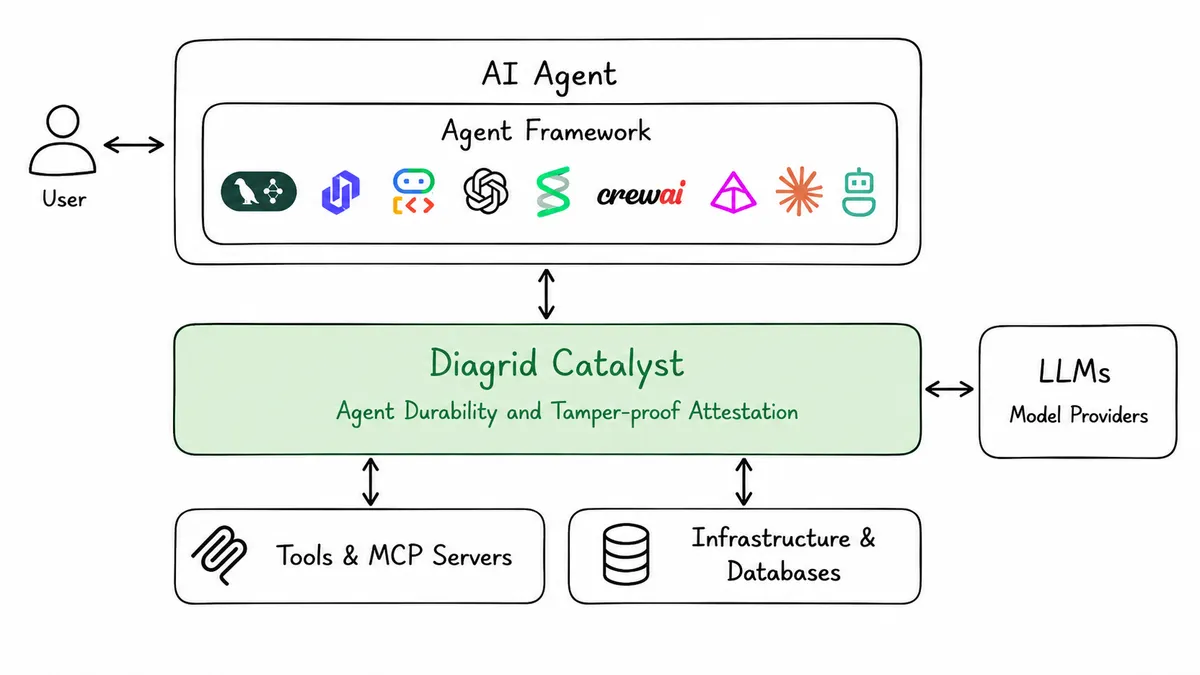
Fig 2: Diagrid Catalyst sits as a durable execution layer between AI agents and downstream infrastructure, extending existing frameworks with production reliability.
Below are the core platform capabilities that enable production-ready AI agents with Diagrid Catalyst:
Persistent workflow state and long-running execution
Diagrid Catalyst goes beyond basic checkpointing. A checkpoint simply records the state of a workflow at a particular point in time. If the workflow fails, it tells you where execution stopped, but not how to recover safely.
With Diagrid Catalyst, you combine checkpointing with durable execution, which uses persisted state, workflow history, recovery semantics, and orchestration to resume execution after a failure. It not only records progress but also determines how the workflow should resume without repeating completed tasks or losing execution context. This enables long-running workflows to proceed safely across interruptions.
Exactly-once workflow execution
Diagrid Catalyst prevents completed workflow steps from running again during recovery. When a workflow resumes after a failure, previously completed model calls, tool calls, and workflow activities are restored from the stored execution history rather than being executed again.
This exactly-once guarantee applies to workflow executions managed by Diagrid Catalyst. For external operations such as API requests, payments, or database updates, developers must still design activities to be idempotent, as external systems may process repeated requests differently. Diagrid Catalyst provides durable state management, workload identity, and verifiable execution records that make it easier to implement idempotency keys and reconciliation logic for these operations.
Automatic recovery
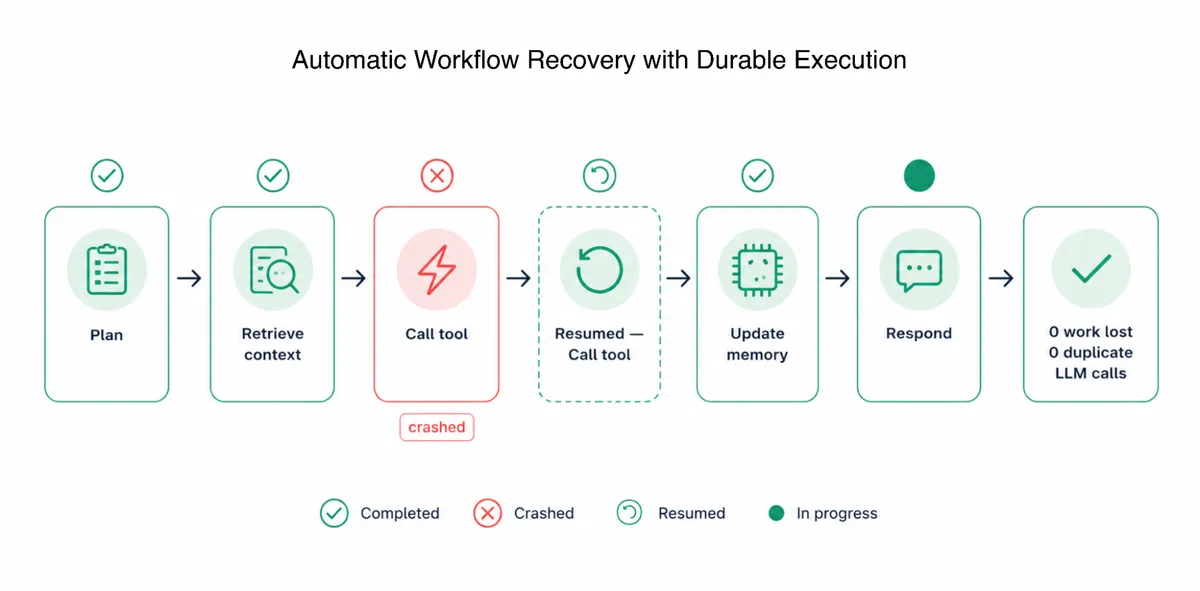
Fig 3: Workflow resumes from the point of failure without losing progress or repeating completed work.
Diagrid Catalyst builds upon Dapr Workflows to automatically recover interrupted agent workflows. It intercepts model calls, tool calls, and agent handoffs, registering them as durable workflow activities.
Workflow executions interrupted by process crashes or infrastructure outages automatically resume from the last completed step instead of restarting from the beginning. Developers do not need to build custom recovery logic for each supported framework because workflow continuation is managed by the execution layer.
Zero trust security for agents and tools
Diagrid Catalyst applies zero-trust principles to communication between agents, applications, and MCP servers. Each workload is assigned a SPIFFE identity, and mutual TLS authenticates every connection.
Policy-based access controls follow a default deny rule to only allow communication between explicitly authorized applications, agents, and tools. These controls are implemented at the execution layer, helping to prevent unauthorized tool access, agent impersonation, and privilege escalation throughout agent workflows.
Verifiable execution for governance and compliance
Diagrid Catalyst records every workflow step in a cryptographically verifiable, signed execution history. With Diagrid Catalyst's observability features, each model call, tool invocation, and workflow activity is linked through provenance records and protected by tamper-evident signatures.
If the workflow history is modified, removed, or reordered, the change gets detected and verification fails. Diagrid Catalyst also includes end-to-end distributed tracing across agent workflows, providing visibility into execution paths, service interactions, and failures. Distributed traces and signed execution history provide the evidence needed to understand how an agent reached a decision. They also verify that the execution history remains intact for audits and compliance.
Moving from prototypes to production
Production agents need production infrastructure. Diagrid Catalyst provides the reliability layer needed to run agents in production, allowing teams to focus on developing agents rather than managing operational overhead.
With Diagrid Catalyst, workflows are always carried to completion. Agents automatically recover without losing state or causing duplicate executions. Every step is cryptographically attested and recorded in a tamper-proof record, so you can verify precisely what an autonomous agent did.
The table below highlights how Diagrid Catalyst compares to building without it:
| Capability | Without Diagrid Catalyst | With Diagrid Catalyst |
|---|---|---|
| Workflow state | Agents can lose progress after failures and restart from the beginning | Agents resume from the last completed step with persisted state |
| Recovery | Developers build custom retry and recovery logic | Workflows automatically recover from crashes, outages, and deployments |
| Execution reliability | Completed steps may run again during recovery | Completed steps are restored from history instead of rerunning |
| Security | Shared credentials make access control difficult | SPIFFE identities, mTLS, and policies secure agent interactions |
| Governance | Limited visibility into agent actions and decisions | Verifiable execution history, provenance, and tracing provide auditability |
Where to go next
Agents perform impressively in demos but fall apart when deployed in production environments. Diagrid Catalyst provides the production infrastructure that helps close gaps before you deploy, and even when agents fail, it enables them to automatically resume without losing progress.
If you're ready to build production-ready agents, the following resources will help you get started with Diagrid Catalyst and durable execution.
For the other failure modes on this list, the Make AI Agents Durable path has five more hands-on courses across LangGraph, DeepAgents, the Microsoft Agent Framework and Dapr Agents.
