The Latest State of Dapr Report 2026
The 2026 State of Dapr report is now available. See how the Dapr community is using workflows, AI agents, and MCP servers, and what it takes to move from prototype to production.

Mark Fussell
Co-Founder & CPO
I am thrilled to announce that the latest State of Dapr Report is available, now in its third year of publication. There is always so much information that we receive from the Dapr community each time. What stands out most to me in this year's report is that Dapr is continuing to evolve alongside the way modern applications are being built.
For a long time, the conversation around Dapr centered on microservices. That is still true. But the 2026 report makes something else clear: developers are now increasingly using Dapr for workflows, AI agents, and MCP-connected systems as these application patterns move to production. In many ways, this is expected, after all, I often refer to agents as microservices plus LLMs. All the underlying patterns, communication, security, and distributed computing are still required, just abstracted through the agent framework itself.
This shift is one of the most important takeaways in this year's report.
We are seeing a growing number of teams building agentic applications, and at the same time we are seeing strong adoption of the Workflow API as part of modern distributed system design. To me, that is significant. It suggests that developers are not only experimenting with new AI patterns but are also looking for ways to make them more durable, orchestrated, and production-ready.
Another thing that stands out is the growing importance of MCP servers in the conversation. This is not surprising given MCP's meteoric rise, with hundreds of millions of SDK downloads per month. However, as the ecosystem matures, the challenge is no longer just about connecting models to tools. Teams are now thinking more seriously about security, governance, discovery, integration, and resiliency. Those are exactly the kinds of concerns that appear when something starts moving from hype and prototyping into real implementation. More than ever, DevSecOps teams are dictating how the agents are deployed and managed within the organization.
That is why I find this year's report so interesting. It does not just point to excitement around AI agents. It shows where the friction is. It shows the gap between experimentation and production. And it highlights the fact that building these systems well requires more than model access alone. It requires reliable and secure application architecture.
The report also reinforces something we continue to hear from the Dapr community: developers want to spend less time reinventing distributed systems patterns and more time focused on business logic. Whether the application is a microservice, a workflow-driven system, or an agentic application, that need remains the same.
From my perspective, this is the bigger story behind the report: Dapr is increasingly becoming part of the foundation for the next generation of distributed applications, with AI now integral to it. Not because the industry needs more complexity, but because developers need consistent building blocks to handle it. The Conversation API provides an incredibly easy way to switch out models, and organizations are switching frequently in the model arms race. However, the Conversation API provides much more to the developer than just model choice, with data obfuscation, token tracking, prompt caching, and more, generalizing common patterns.
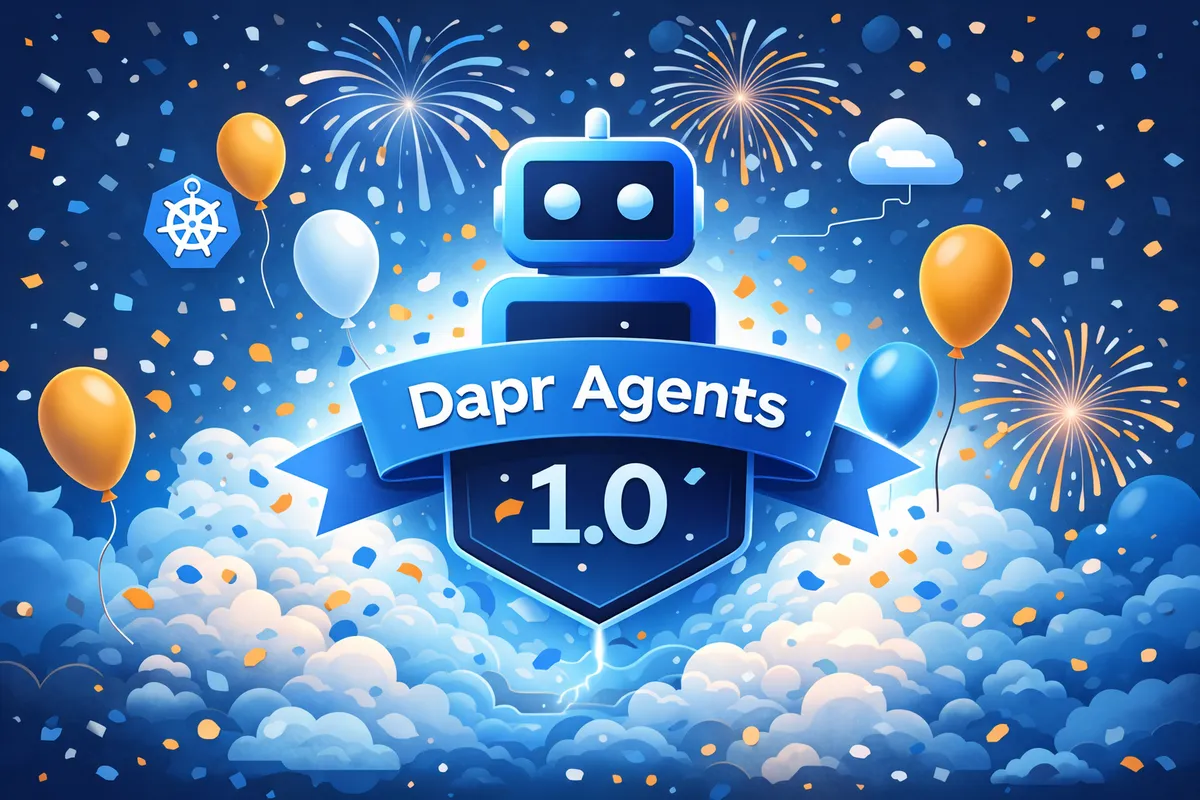
Just last month Dapr Agents reached its v1.0 release, a huge milestone, driven by the incredible community building thousands of agents in different sectors. I am still blown away by how much capability it provides with so few lines of code that most other agent frameworks are still figuring out how to build. That is the power of Dapr as a mature, open-source project.
If you want to understand where the Dapr ecosystem is heading, how teams are thinking about AI agents, workflows, and MCP servers, and what trends are shaping the next phase of application development, I encourage you to download the report. This is a single snapshot in the journey of the Dapr project, but it offers clear insight on where the industry is headed.
Download the State of Dapr 2026 report to explore the trends, the signals, and the questions that are defining what comes next for Dapr.