Patchmageddon Is Coming: What the EU Cyber Resilience Act Means for Dapr Users
If you ship software into the EU with Dapr inside it, the CRA makes those vulnerabilities yours to remediate. Reporting obligations start 11 September 2026.

Mark Fussell
CEO & Co-Founder
If you ship software into the European Union and there is open source inside it, the Cyber Resilience Act is now your problem. Not the upstream maintainers' problem. Yours. And the timing is bad: the regulation lands just as AI-driven vulnerability discovery has broken the patching model it assumes.
Patchmageddon: exploitation now moves faster than patching
Start with what changed this year, because it reframes everything that follows. Frontier models can now find previously unknown vulnerabilities at scale, and the patching side has not kept up. J.P. Morgan's July 2026 Eye on the Market report, "Patchmageddon," draws on contributions from the bank's senior cybersecurity, information security, open source, and AI policy leaders. It assembles the numbers:
- Attacker time to exploit has crossed zero. Median time from disclosure to first confirmed exploitation fell from roughly one year in 2021 to one day in 2026, and is projected to reach one minute by 2027. Almost 80 percent of exploitations now occur on or before the day of disclosure. Organizational mean time to remediate went the other way, rising to roughly 95 days.
- The volume cannot be managed reliably through manual processes alone. 48,185 CVEs were disclosed in 2025 against roughly 7,500 patched.
- Turning a patch into an exploit is mechanical. Once a vendor ships a fix, a model can reverse-engineer it and produce a working exploit in minutes. Anthropic's red team turned known vulnerabilities into working privilege escalation exploits in under a day, for under $2,000, with no human involvement.
- Detection has outrun the advisory system. 95 percent of the vulnerabilities disclosed through Anthropic's Project Glasswing had no public advisory at the time of the research snapshot, so they were not visible through CVE reports, the National Vulnerability Database, or GitHub advisories.
- Upstream cannot absorb the load. Of the high and critical severity findings Anthropic reported to open source maintainers, 530 were reported and 75 were patched. Tuskira Research found discovery outpacing patching by 16.5x even with 90 percent maintainer acknowledgement.
Source: J.P. Morgan, "Patchmageddon," July 2026, drawing on Zero Day Clock, Sidero Labs, Mitiga.io, Anthropic, and Tuskira Research.
That is the environment the Cyber Resilience Act now lands in. The CRA was developed before the latest generation of AI security models dramatically accelerated vulnerability discovery and exploit development. The operational environment in which companies must comply is therefore much harsher than it was when the legislation was proposed.
The law, and where it came from
For most of the software industry's history, product security has been voluntary in Europe. A vendor could ship with known vulnerabilities, stop patching whenever it suited them, and face no regulatory consequence. The CRA ended that. It was a long time coming: the Commission's 2020 EU Cybersecurity Strategy called for horizontal rules on connected products, Ursula von der Leyen announced the Act, and the Commission published the proposal on 15 September 2022, citing that roughly two thirds of attacks trace back to vulnerabilities and around 60 percent of products ship with known vulnerabilities in them. SolarWinds, which reached more than 18,000 organizations, and Log4Shell landed during that drafting window and removed most of the remaining political resistance. The final text was published on 20 November 2024 as Regulation (EU) 2024/2847 and entered into force on 10 December 2024.
Any product with digital elements placed on the EU market must now meet binding essential requirements: secure by design and by default, no known exploitable vulnerabilities at release, a software bill of materials, vulnerability handling across a declared support period, free security updates, technical documentation, conformity assessment, and CE marking. Actively exploited vulnerabilities and severe incidents are subject to mandatory reporting through the CRA reporting mechanism, beginning with a 24-hour early warning and followed by additional notification requirements. It is CE marking applied to software security.
The penalties are structured to be felt. Breaching the essential requirements or core manufacturer obligations can bring fines of up to 15 million euros or 2.5 percent of total worldwide annual turnover, whichever is higher, with lower tiers of 10 million or 2 percent for other obligations and 5 million or 1 percent for supplying misleading information to authorities. Turnover means everything the company takes in globally, before costs. Where you are incorporated is irrelevant: the CRA applies to any company, European or not, placing a product on the EU market.
The part most teams miss: it covers the open source you did not write
For the manufacturer of the finished product, the CRA does not let you ignore a component simply because you did not write it. If you ship a product into the EU and Dapr is inside it, you are the manufacturer and Dapr is your responsibility as an integrated component. The same is true of every other dependency in your container images, manifests, and build chain. Free, community-maintained, and widely adopted are not defenses.
Although the CRA includes protections for non-commercial open source development, those protections do not exempt a company that incorporates open source into a commercial product. Greg Kroah-Hartman made the point directly in his day two keynote at KubeCon Europe 2026, arguing that the CRA correctly places responsibility on companies shipping products rather than the maintainers writing the code, and framing the SBOM requirement as a list of ingredients rather than a bureaucratic tax. Market surveillance authorities can request the SBOM for a product with digital elements. If Dapr is in your product, it will be on that list.
It is a bigger surface than most teams picture. Between 96 and 99 percent of commercial codebases contain open source, roughly 77 percent of the underlying code is prebuilt libraries and frameworks, and the mean commercial application carries around 1,180 open source components. Most are not direct. The average JavaScript project on GitHub has 683 indirect dependencies against 10 direct ones, and roughly 95 percent of open source vulnerabilities sit in those transitive layers.
The industry is not ready. The 2026 CRA Awareness and Readiness Report from Linux Foundation Research and OpenSSF, based on 843 respondents and a security analysis of more than 12,000 open source projects, found 39 percent of manufacturers still unaware of or uncertain about their obligations, roughly four in ten unsure whether the regulation applies to them at all, and only 32 percent generating an SBOM for all of their products. Awareness has barely moved in a year. The deadlines have not.
The dates that matter
| Date | What changes | Application |
|---|---|---|
| 10 December 2024 | The CRA enters into force and the phased timeline begins | In force |
| 11 June 2026 | Rules for notifying conformity assessment bodies apply | Applies |
| 11 September 2026 | Vulnerability and incident reporting obligations apply, including for products already on the market | Applies from this date |
| 11 December 2027 | Main obligations apply in full: conformity assessment, CE marking, technical documentation, SBOM, support period | Applies from this date |
The reporting duty beginning in September 2026 applies before the main obligations and reaches products already on the market. It deserves attention well ahead of the December 2027 date.
Does the CRA apply to you?
The obligation falls on the manufacturer or integrator of the finished product, so how you use Dapr matters more than the fact that you use it. Three cases cover most teams.
Clearly in scope: you ship an on-prem product, appliance, or customer-deployed software into the EU with Dapr embedded for service invocation, pub/sub, state, or workflows. The work between now and September 2026 is to inventory every Dapr-dependent product, name an owner for each, and stand up vulnerability intake and reporting. By December 2027 each one needs a declared support period and a documented compliance path.
The hard case: a physical product or customer-hosted software whose function depends on a Dapr-backed cloud service, such as device fleet control, remote policy distribution, or event routing. Standalone SaaS is generally outside scope, but a remote data processing solution that a product needs in order to function is not. That call decides the outcome and is worth a joint legal and product review now rather than after an incident. The Commission has said this area is being clarified in further guidance.
Probably out of scope: you run open source Dapr only for internal systems, such as internal order processing or a developer platform, and do not sell that software into the EU. The Commission has confirmed that building for your own use is not placing a product on the market. A dedicated compliance project is usually unnecessary, but staying on supported Dapr releases still matters, because patches only reach supported versions.
What the CRA expects of the Dapr inside your product
Once in scope, Dapr is treated like any other third-party component. The regulation allows open source components, including ones outside its own scope that carry no CE marking. What it asks in return is that you show they do not weaken the security of what you release. The Commission FAQ points to concrete due diligence: checking a component's update history, watching vulnerability databases, running extra security testing, using software composition analysis, and reviewing an SBOM.
You own Dapr vulnerabilities for the life of your product.
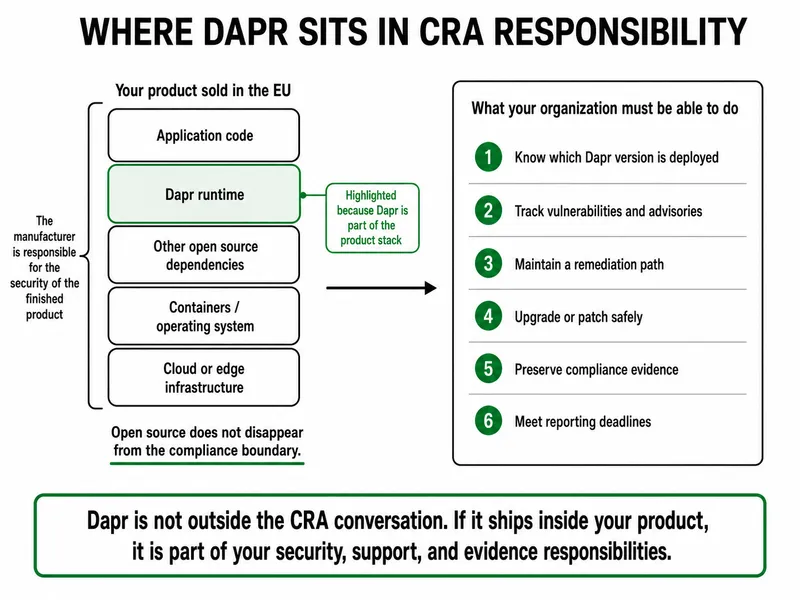
If a flaw affects what you shipped, you remediate it during your declared support period, even when the upstream project does not. How is left open: patch the component yourself, disable the affected function, or swap it out. Alongside that you need a declared support period, which will generally need to be at least five years unless the product is reasonably expected to be used for a shorter period, a coordinated disclosure process, a named contact point, and working reporting flows.
Supported versions carry weight. Dapr OSS supports the current minor release and the previous two, with security patches limited to those releases. This is a common and often hidden failure point. Across the industry the median dependency now sits 278 days behind its latest major version, up from 215 a year earlier, and roughly 92 percent of codebases contain components four or more years out of date. Against a window of the current minor plus two, a lag like that puts you outside the patchable range before anyone has filed a ticket.
In practice, that means your CRA program must extend beyond the code your employees wrote. It should cover every material open source dependency and answer questions such as:
- Which versions of Dapr are present in each product and deployment?
- Is each version still supported, and how quickly can it be upgraded?
- Who monitors Dapr security advisories, vulnerability databases, and upstream releases?
- How will you assess whether a Dapr vulnerability affects your product and its intended use?
- Can you remediate, mitigate, or replace an affected component during the full product support period?
- Can you produce an SBOM, risk assessment, test evidence, change record, and vulnerability-handling history for an authority or customer?
- Can your reporting process meet the CRA deadlines when an actively exploited vulnerability or severe incident is identified?
This is the source of the urgency—and, for many organizations, the fear. A product team may have hundreds or thousands of open source components, yet CRA accountability sits with the company placing the finished product on the market. A dependency without a predictable patch path, supported release policy, security contact, or operational owner can become a product-compliance gap. The right response is not to abandon open source. It is to operate it with the same discipline expected of any production dependency.
Where the new math collides with the regulation
Three of the facts at the top of this post run straight into what the CRA asks of you.
First, "no known exploitable vulnerabilities" gets harder to assert. When discovery volume climbs this steeply across a dependency tree of a thousand-plus components, the set of known vulnerabilities grows faster than most release cadences.
Second, due diligence by CVE feed stops working. The Commission's guidance points you at vulnerability databases and SBOM review, which assumes the databases are current. If 95 percent of AI-discovered vulnerabilities have no advisory yet, an SBOM checked against the NVD tells you what has been written down, not what is known.
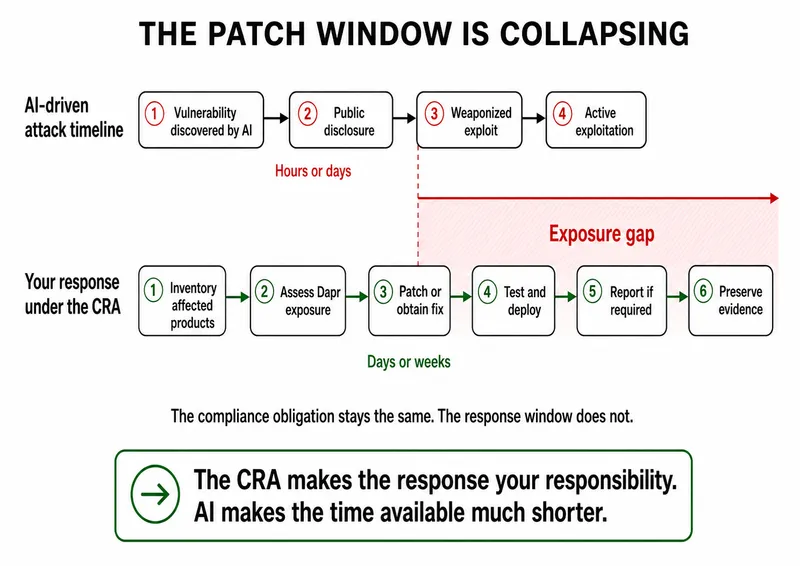
Third, the 24-hour clock and the upstream patch clock now overlap. From 11 September 2026 you have 24 hours to file an early warning on an actively exploited vulnerability. If exploitation happens on day zero and the upstream fix takes two weeks, you will be filing before the patch exists. The regulation lets you mitigate by disabling the affected function or replacing the component, but only if you already know which component sits where and who has authority to act.
J.P. Morgan's own analysis found that simply moving to current versions across all open source dependencies eliminated about half of their high and critical issues. That is the practical takeaway: version currency is no longer hygiene; it is one of the highest-leverage compliance controls available.
You are not reading this alone
The bodies that steward the cloud native stack have been building CRA guidance since before the Act entered into force, and organizations, not maintainers, are the audience for most of it. The CRA was one of three themes that dominated KubeCon Europe 2026. CNCF TAG Security and Compliance maps SBOM generation, minimal images, and secure CI/CD onto CRA requirements. The OpenSSF Global Cyber Policy Working Group runs a CRA portal, a standards map, and LFEL1001, a free 90-minute course. The Eclipse Foundation's Open Regulatory Compliance Working Group produces shared interpretation and FAQs across foundations. None of it removes your obligation. It tells you the ecosystem stopped debating whether the CRA applies and started building the tooling to comply.
The CRA is also only the product-level layer of a wider stack. If you ship into the EU you are likely under more than one of NIS2 for organizational cyber risk, the new Product Liability Directive which treats software as a product and turns a missing security update into a potential defect claim, the AI Act for high-risk systems, and DORA if you sell into financial services. They share the same underlying evidence: what is in your software, how you patch it, and how fast you can prove both.
How Diagrid helps you close the gaps
The requirements point to a single underlying need. You have to run Dapr in a way that is secure by default, stays patchable, and produces evidence you can show.
Diagrid Dapr OSS Support
Diagrid Dapr OSS Support suits teams staying on community Dapr who need a credible remediation path: a production SLA, CVE fixes, escalation paths, and expert guidance, so a Dapr vulnerability does not leave you waiting on the upstream release cycle. Your CRA obligations stay yours, but the remediation work behind them becomes contractual rather than best effort.
D3E: a security-enhanced Dapr distribution
D3E is Diagrid's security-enhanced Dapr distribution, including FIPS compliance. A hardened build, custom version backports for CVEs, minimized RBAC, and multi-tenant isolation, for teams that need hardened defaults and longer supportability inside a regulated product.
Conductor: controlled operations and upgrade evidence
Conductor manages the operational side of Dapr OSS on Kubernetes. Transactional scheduled upgrades and downgrades with automated rollbacks, zero-downtime certificate management, security advisories, multi-cluster visibility, RBAC, and audit logs. This is the version currency problem solved directly, and it answers the question a market surveillance authority will eventually ask: can you patch quickly and safely, with a record to show for it.
Catalyst: reducing the runtime operations burden
Catalyst runs the Dapr sidecars and control plane for you, with automation, identity, governance, and operational control on top. It substantially reduces the operational burden and can hand off much of the Dapr runtime operation. It does not remove your CRA obligations for your own in-scope product, so treat it as a way to shrink the work while those obligations stay yours.
A practical CRA readiness checklist for Dapr users
Start with this practical checklist:
- Identify every product placed on the EU market that embeds Dapr or depends on a Dapr-backed remote service.
- Record the Dapr runtime, CLI, SDK, component, and deployment versions in the product SBOM and asset inventory.
- Assign a product owner, security owner, and engineering escalation path for each Dapr-dependent product.
- Confirm whether the deployed Dapr versions are supported and define an upgrade or extended-support plan.
- Document secure configuration decisions, including identity, authorization, secrets, network access, component scopes, and control-plane permissions.
- Create a repeatable process to assess Dapr advisories and vulnerabilities against actual product use.
- Test the path for patching, backporting, mitigating, rolling back, and producing customer-facing updates.
- Align the product support period with a realistic Dapr maintenance and remediation commitment.
- Preserve evidence: risk assessments, SBOMs, test results, approvals, release records, upgrade history, and incident decisions.
- Measure and reduce the time from vulnerability discovery to impact assessment, remediation decision, tested patch, and production deployment.
- Make the September 2026 reporting process operational now, including legal and executive escalation.
Where to start
If your product ships into the EU with Dapr inside it, run a scope check. Confirm which products are affected and who owns each one. Then answer three questions honestly: can you produce an SBOM for every shipped product today, how far behind current are your dependencies including Dapr, and how long does it take to get a patched build into a customer's hands? The third is frequently the least prepared. If the answer is measured in weeks and exploitation is measured in hours, that is your September 2026 gap.
You can schedule a free scope call with our customer success engineering team, who have been readying organizations for this for the last couple of years. From there the choice is about operating model: Diagrid Dapr OSS Support to keep your current setup, D3E for a hardened distribution with longer support timeframes, Conductor for upgrade evidence and control, or Catalyst to substantially reduce or hand off Dapr runtime operations.
The regulation leaves room to keep Dapr. What changes is the standard for how you run it. The deadline is December 2027, but the thing forcing the issue is not the deadline. It is that exploitation now moves in hours and remediation still moves in weeks. Closing that gap is worth doing whether or not you ship into Europe. The CRA turns that operational imperative into a legal obligation for products placed on the EU market.
Further reading
- Regulation (EU) 2024/2847, the Cyber Resilience Act, full text
- European Commission CRA implementation FAQ
- CNCF: CRA updates - the open source community has been listened to
- CNCF on-demand webinar: EU Cyber Resilience Act repercussions in open source
- Patchmageddon, Eye on the Market, Michael Cembalest, J.P. Morgan, July 2026
- 2026 CRA Awareness and Readiness Report, Linux Foundation Research and OpenSSF
- OpenSSF Global Cyber Policy Working Group CRA portal
- Dapr OSS support and release policy