

The Evolution of AI Agents · Chapter 5 of 7 · Stage 5 — The Kubernetes control loop · 2010s–2020s
The Kubernetes Control Loop Changed the Question

Mark Fussell
Co-Founder & CPO, Diagrid · September 3, 2026
The Kubernetes control loop at a glance · 2010s–2020s
- What owns the control flow
- The controller, driven by a declared goal
- What it added
- Continuous reconciliation toward a desired outcome, not a fixed sequence
- What it could not do
- Choose a novel next action - reconciliation logic is written by a developer
- Agent equivalent
- A goal-directed agent, minus the probabilistic decision step
A control loop is a loop that continuously compares the desired state of a system with its actual state and acts to close the gap. Kubernetes made the control loop, also called a reconciliation loop, the core of its operating model: you declare what you want, and controllers keep acting until reality matches. AI agents follow the same outcome-oriented shape, with a language model making the decision.
Then came 2014. Kubernetes Control Loop Changed the Question
Kubernetes introduced another kind of loop that is especially relevant to agents, because it changes the question from “what happened?” to “what outcome am I trying to reach?” The Kubernetes controller continuously compares desired state with actual state and takes action to reconcile the two.
You might declare:
Desired replicas = 3
The controller observes:
Actual replicas = 2
and then acts to close the gap.
Conceptually:
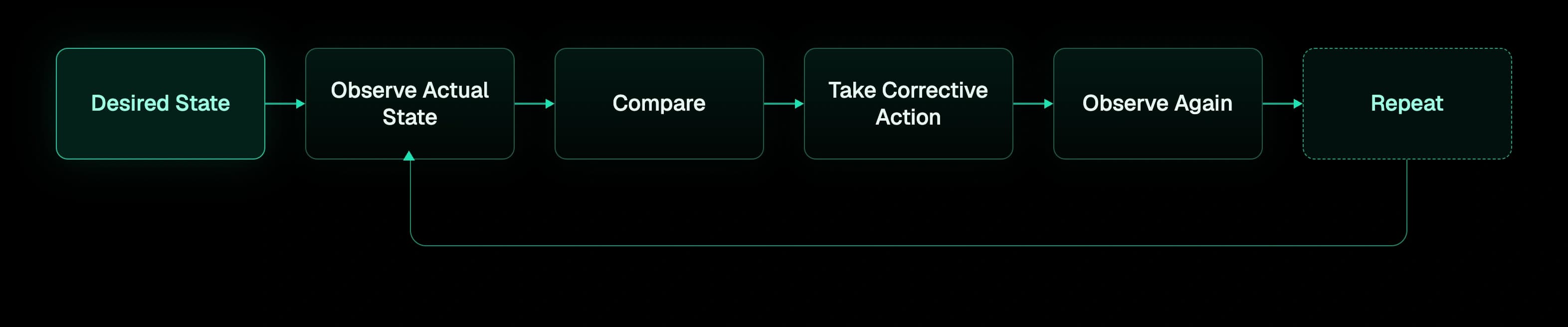
This is a powerful programming model because the system is not executing a fixed sequence toward a predetermined final step. It is continually asking whether reality matches the desired outcome, and if not, what it should do to move closer. As Donkey said in Shrek, “Are we there yet?”
That is an important shift. The Windows loop is primarily about reacting to events. The game loop is primarily about advancing a changing world. The Linux event loop is primarily about efficiently waiting for and dispatching work. The Kubernetes control loop is primarily about reconciling actual state with desired state. And that starts to sound very close to an agent.
Why this matters if you are building agents
This is the stage that reframes the whole conversation about workflow orchestration for agents. The controller pattern does not execute a plan; it compares desired state vs actual state and closes the gap, repeatedly, until reality matches intent. That is a far better mental model for an agent than a DAG is.
Keep the distinction sharp, though. A Kubernetes controller reconciles with deterministic logic a human wrote. An agent reconciles with a language model's judgement. Same shape, radically different guarantees - and Chapter 6 is where that difference starts to bite.
Frequently asked questions
About the author
Mark Fussell — Co-founder and Chief Product Officer of Diagrid and co-creator of Dapr. He was a Windows 3.0 developer in the early nineties — the message loop in Chapter 2 is his, not a history lesson — and has spent the three decades since on distributed systems, most recently making them durable for agents.
LinkedInRead next
Chapter 6 reaches the 2020s and the agent loop itself - where the step that decides what happens next stops being code.
Chapter 6: The agent loopAll seven chapters are live.
Read The Evolution of AI Agents end to end, or get the next special project when it ships.